
Chest Pain After Angioplasty or Bypass: Why It Can Happen and What to Do Next
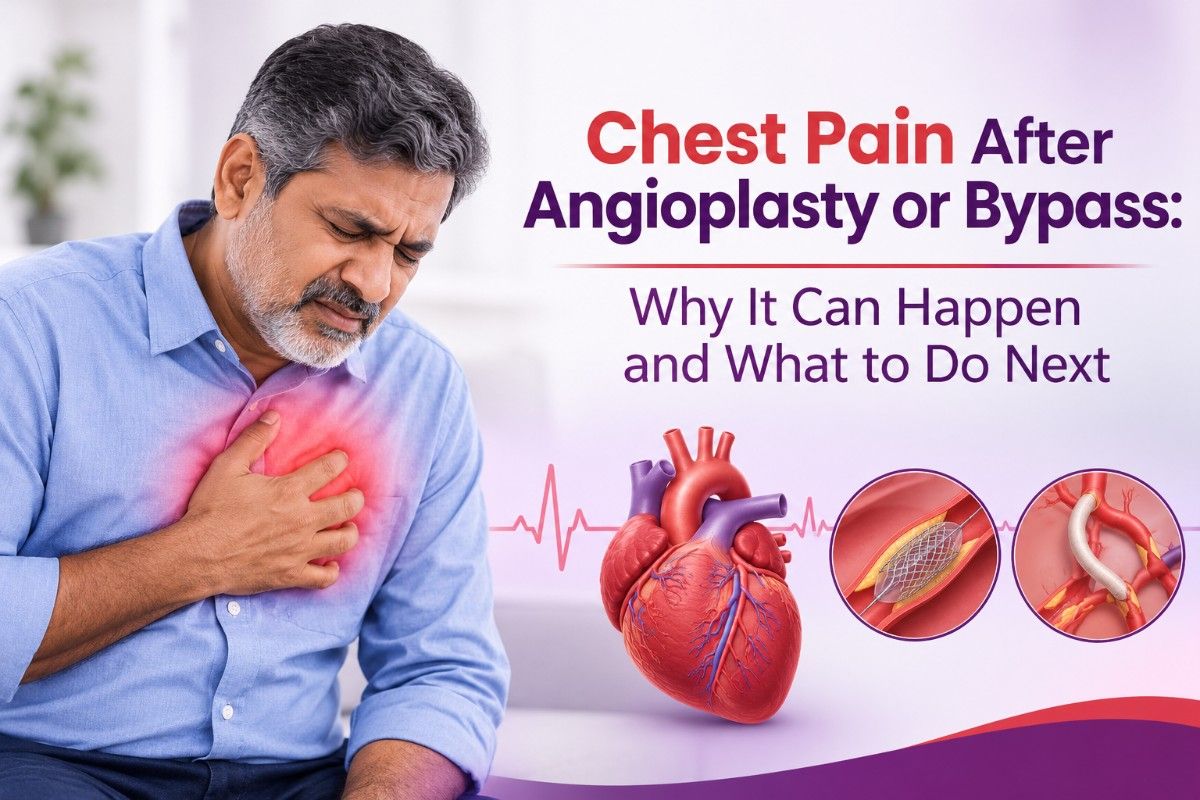
You went through a stent or bypass surgery to fix your heart, so chest pain afterward can feel like a betrayal. Many people quietly wonder whether the procedure failed, whether they did something wrong, or whether they should be rushing to hospital.
Here is the direct answer. Chest pain after angioplasty or bypass is common, and it does not always mean something is seriously wrong. Some of it is simply healing. But some of it is angina returning, and that needs a proper look from a cardiologist. A small number of causes are emergencies. The task is to work out which kind of pain you have, and this article explains how that is done and what usually happens next.
If you are having severe, crushing or unexplained chest pain right now, stop reading and call emergency services (108 in India).
FIRST THINGS FIRST: IS THIS AN EMERGENCY?
Call emergency services immediately, and do not drive yourself, if you have:
- Chest pain that is severe, crushing, or lasts more than a few minutes
- Pain that spreads to the arm, jaw, neck, back or upper stomach
- Chest pain with sweating, nausea, breathlessness, lightheadedness or fainting
- A new or unusual return of the symptoms you had before your procedure
- Pain at rest that is getting worse or more frequent
- A fast or irregular heartbeat with chest discomfort
These patterns can mean a heart attack, a blocked stent or a blocked graft, and time matters. If you are not sure, treat it as urgent. It is far better to be checked and reassured than to wait.
Many other cases are less dramatic, and the next sections cover them. But please do not use this article to decide that emergency pain can wait.
WHY DO I STILL HAVE CHEST PAIN AFTER A STENT?
An angioplasty treats one narrowed spot in one artery. It does not cure the underlying coronary artery disease, and it cannot treat every source of chest pain. After a stent, pain can come from several places.
Healing and non-cardiac causes
Chest discomfort in the first days or weeks is common and often not due to ischaemia (insufficient blood supply). Possible reasons include:
- Stretching of the artery wall by the balloon or stent, sometimes called stretch pain
- Soreness at the wrist or groin access site
- Muscle strain from lying still on the procedure table
- Acid reflux, which can feel remarkably like heart pain
- Anxiety, which can cause chest tightness and palpitations
Studies suggest that chest pain after a procedure is frequent, and that only a minority of such pain is actually due to a new heart event. That is reassuring, but it does not mean every episode can be ignored, particularly as pain after a stent can occasionally signal a higher chance of later narrowing.
Cardiac causes that need medical assessment
- In-stent restenosis. Scar-like tissue can grow inside the stent and gradually narrow it again. It most often appears within the first six months, with a peak around months four to six, but can happen later. The pain usually resembles your original angina.
- In-stent thrombosis. A clot forms inside the stent. It is uncommon, but it is an emergency, and it is more likely if antiplatelet medicines are stopped early. It usually causes sudden, severe pain.
- Incomplete revascularisation. If you had more than one blockage, some may not have been treated, or may not be treatable with a stent.
- Disease progression. A new blockage can develop in a different part of the same artery, or in another artery.
- Microvascular dysfunction. The tiny blood vessels that feed the heart muscle may not widen properly, causing angina even when the larger arteries and the stent look open. This is more common in people with diabetes and in women.
- Coronary spasm. An artery can tighten temporarily, causing pain that often occurs at rest or at night.
People with diabetes, older adults and women may feel breathlessness, fatigue or an odd discomfort rather than classic chest pain, so unusual symptoms still deserve attention.
IS CHEST PAIN NORMAL AFTER BYPASS SURGERY?
Some chest discomfort is normal after bypass surgery, particularly in the weeks after the operation. But there are two very different kinds of pain to separate.
Healing pain
During standard bypass surgery, the breastbone (sternum) is divided and then wired back together. Soreness around the centre of the chest, stiffness, a clicking or pulling sensation, and aching in the muscles, ribs and shoulders are common. Patient guidance from surgical centres notes that sternal discomfort can take six months or more to settle fully. Leg or arm incisions, where grafts were taken, can also ache, tingle or feel tight.
Healing pain typically gets better over time, is worse with movement, deep breathing, coughing or touch, and is felt at or near the incision. Inflammation around the heart or lungs, or a wound problem, can also cause pain, and fever, redness, drainage from the wound, or a pain that is getting worse should be reported promptly.
Angina returning
Bypass grafts carry blood around blockages, but they are not permanent. Over months to years, a graft can narrow or close, particularly vein grafts, and the disease in your own arteries can progress. Studies of patients who needed further treatment for recurrent angina found graft failure, with or without progression of native disease, to be the main reasons. Arterial grafts tend to last longer than vein grafts.
If your pain comes on with walking, stairs or stress, eases with rest, and feels like the angina you had before surgery, ask your cardiologist to review it. Angina after bypass, especially in the first year or after several years, is a recognised problem and one that has defined evaluation pathways.
HOW TO TELL THE DIFFERENCE: A PATTERN GUIDE
This table is for orientation only. It does not replace a medical assessment, and symptoms may overlap.
| Pain Pattern | May Suggest | What to Do |
|---|---|---|
| Sharp or aching pain at the incision, worse with movement, coughing, or touch | Healing of the chest wall or breastbone | Mention it at your next review. Report it sooner if the pain worsens or is accompanied by fever or wound changes. |
| Mild, short twinges in the first few weeks after a stent | Stretching discomfort or healing | Report the pain if it becomes frequent, worsens, or persists. |
| Pressure or tightness while walking or climbing stairs, relieved by rest | Possible angina due to narrowing of a coronary artery | Arrange a cardiology review promptly. |
| Pain at rest or during the night that is new or increasing | Possible coronary artery spasm or unstable heart disease | Seek urgent medical attention. |
| Burning pain after meals, relieved by antacids | Possible acid reflux | Mention it to your doctor, as reflux and heart-related pain can overlap. |
| Sudden, severe, or prolonged pain accompanied by sweating, nausea, or breathlessness | Possible heart attack or blocked stent or bypass graft | Call emergency services immediately. |
Important: Chest pain after angioplasty or bypass surgery should not automatically be assumed to be part of the healing process. New, worsening, or persistent chest pain needs medical assessment. If the pain is severe, prolonged, or accompanied by sweating, nausea, or breathlessness, seek emergency care immediately.
HOW DOCTORS FIND THE CAUSE
A cardiologist begins with a careful history: when the pain started, what triggers or relieves it, how long it lasts, and whether it resembles earlier angina. Details matter, including when you had your procedure and whether you have missed any medicines. Then, depending on your situation, the work-up may include:
- A resting ECG, ideally also during pain if possible
- Blood tests, including markers of heart muscle injury when appropriate
- An echocardiogram to assess pumping strength and valves
- A treadmill test, stress echo or nuclear scan to see whether effort triggers reduced blood flow
- CT coronary angiography, which can look at arteries, stents and grafts depending on the case
- Invasive coronary angiography when symptoms or tests suggest a treatable narrowing
- Further assessment of small-vessel function or spasm where the main arteries look open
A diagnosis requires a qualified clinician, and general descriptions online cannot substitute for it. Notes on your pain, your reports and your procedure details will help.
WHAT HAPPENS NEXT: TREATMENT DEPENDS ON THE CAUSE
There is no single answer. Depending on what is found, the plan may involve:
- Reassurance and watchful follow-up if the pain is clearly healing-related
- Medicine review. Anti-anginal tablets, antiplatelets, statins and medicines for blood pressure and diabetes may be adjusted. Never stop or change them yourself.
- Treating non-cardiac causes, such as reflux, once the heart has been assessed
- A repeat procedure when a specific, treatable narrowing is causing significant symptoms. Guidelines support revascularisation for lifestyle-limiting angina despite medicines when suitable blockages are present.
- Cardiac rehabilitation, which can improve confidence, fitness and symptom control
- Risk-factor control for blood sugar, blood pressure, cholesterol, weight and tobacco
- Specialised approaches for persistent angina when no suitable procedure is available
WHEN MIGHT EECP BE CONSIDERED?
EECP (Enhanced External Counterpulsation) is a non-invasive therapy in which cuffs on the legs inflate and deflate in time with the heartbeat. It is relevant to this topic only in a specific situation: persistent, stable angina after a stent or bypass, when medicines have not controlled it and a further procedure is not suitable or not possible.
In that setting, the 2023 AHA/ACC chronic coronary disease guideline says EECP may be considered for symptom relief.
Whether EECP is appropriate is a decision for a cardiologist after full assessment. Learn more on our pages about EECP after stent or bypass failure and EECP for refractory angina.
WHAT YOU CAN DO IN THE MEANTIME
- Keep taking your medicines exactly as prescribed. This is especially important for antiplatelet tablets after a stent.
- Keep a short symptom diary. Note when the pain occurs, what you were doing, how long it lasts, what relieves it, and any other symptoms.
- Follow your doctor’s written plan for any prescribed emergency medicine, and call emergency services if the pain does not settle as instructed.
- Do not self-diagnose from symptoms or online descriptions, and do not delay an appointment because the pain “comes and goes.”
- Bring all reports, discharge summaries, stent cards and graft details to your appointment.
- Ask questions. How many arteries were treated, whether any blockages remain, and what to do if symptoms recur are all fair things to ask.
LIFESTYLE AND FOLLOW-UP
A stent or bypass treats a problem. It does not remove the reasons the problem developed. These habits matter just as much afterward:
- Attend all follow-up visits and cardiac rehabilitation sessions.
- Eat for your arteries: vegetables, fruit, whole grains, pulses, nuts and fish, with less deep-fried food, sweets, bakery items and salt.
- Stay active as advised by your doctor, usually building up gradually toward brisk walking.
- Stop all tobacco.
- Keep blood sugar, blood pressure and cholesterol within the targets your doctor sets.
- Sleep well and manage stress, since both affect heart symptoms.
Frequently Asked Questions
Why do I still have chest pain after stent placement?
Possible reasons include healing or stretch pain, narrowing in the stent, a blockage elsewhere, a blockage that was not treated, small-vessel problems or non-cardiac causes such as reflux. Only an evaluation can say which applies to you.
How long is chest pain normal after a stent?
Mild, brief discomfort is common in the first days to weeks. Pain that is severe, frequent, comes on with exertion or keeps returning should be reviewed by your cardiologist.
Is chest pain normal after bypass surgery?
Soreness around the breastbone and incisions is common and can last for weeks to months. Pain that comes with exertion, feels like your old angina, or is sudden and severe needs assessment.
Does chest pain after a stent mean the stent has failed?
Not necessarily. Many causes are unrelated to the stent. But narrowing inside a stent is possible, particularly in the first year, so persistent or exertional pain should be checked.
What to do if angina returns after angioplasty?
Contact your cardiologist promptly, keep taking your medicines, and go to emergency care if the pain is severe, prolonged or accompanied by sweating, breathlessness or fainting.
WHEN SHOULD YOU SEE A CARDIOLOGIST?
Book a review soon if you have:
- Chest tightness, pressure or discomfort that returns with activity after your procedure
- Needing more nitrate tablets than before, if prescribed
- New breathlessness, unusual tiredness, dizziness or palpitations
- Pain that is increasing, becoming more frequent or lasting longer
- Swelling of the legs, or fever, redness or discharge at an incision
- Any doubt about whether your symptoms are normal
For emergency warning signs, listed above, call emergency services right away.
CARE AT KGK HOSPITAL, ARUMBAKKAM
KGK Hospital is a non-invasive cardiac care centre in Arumbakkam, Chennai, with a focus on EECP therapy. Dr. K G Krishnaraja, MD, founder and lead physician, specialises in non-invasive cardiology with a focus on EECP and reviews each patient’s history and tests before planning treatment.
If you have chest symptoms after a stent or bypass and would like to talk through your options, including whether EECP could be appropriate, you can book a free initial consultation. KGK is not an emergency service, so please go to the nearest emergency department for urgent symptoms.
KGK Hospital, Chennai: Poonamallee High Road, opposite Panchali Amman Koil Street, Arumbakkam, Chennai 600106
Hours: Monday to Sunday, 11:00 AM to 5:00 PM
Phone / WhatsApp: +91 94456 468 88
Email: kgkhospital@gmail.com
Conclusion
Chest pain after angioplasty or bypass has many possible explanations. Some are part of ordinary healing, some are signs that a stent, graft or another artery needs attention, and a few are emergencies. You do not have to work out which one alone, and you should not wait and wonder.
Know the red flags, keep taking your medicines, note your symptoms, and have anything that comes with exertion, keeps returning or feels like your old angina properly assessed. For persistent angina that other measures have not controlled, there are options, including EECP in selected patients, to discuss with your cardiologist.
If you are living with ongoing chest symptoms after a procedure, we would be glad to listen and help you understand the next step. Speak with a qualified cardiologist about your individual situation.
Disclaimer: This article is for general education and does not replace personal medical advice, diagnosis or treatment. Chest pain can be an emergency. Treatment recommendations depend on an individual assessment by a qualified cardiologist.

About Author
At placerat eleifend nulla inceptos per dolor lacinia posuere. Rhoncus sociosqu dolor pharetra torquent interdum curabitur erat pellentesque.
Share Post :
Recent Posts
-
 EECP Contraindications: Who Should Not Have EECP Therapy?
-
 Chest Pain After Angioplasty or Bypass: Why It Can Happen and What to Do Next
-
 Exercise After a Heart Diagnosis: What Is Safe and What Isn't
-
 Heart-Healthy Diet Tips for Preventing Coronary Artery Disease
-
 Cholesterol and Heart Health: What Your Numbers Really Mean
Categories
- What is EECP? (Educational)
- EECP vs Surgery (Comparison)
- Heart Health Tips Diabetes & Heart Care
- Patient Stories
- EECP in Tamil (தமிழில் EECP)
- Doctor Articles & Expert Advice
Subscribe Newsletter
Signup our newsletter to get update information, news, insight or promotions.
