
EECP Contraindications: Who Should Not Have EECP Therapy?
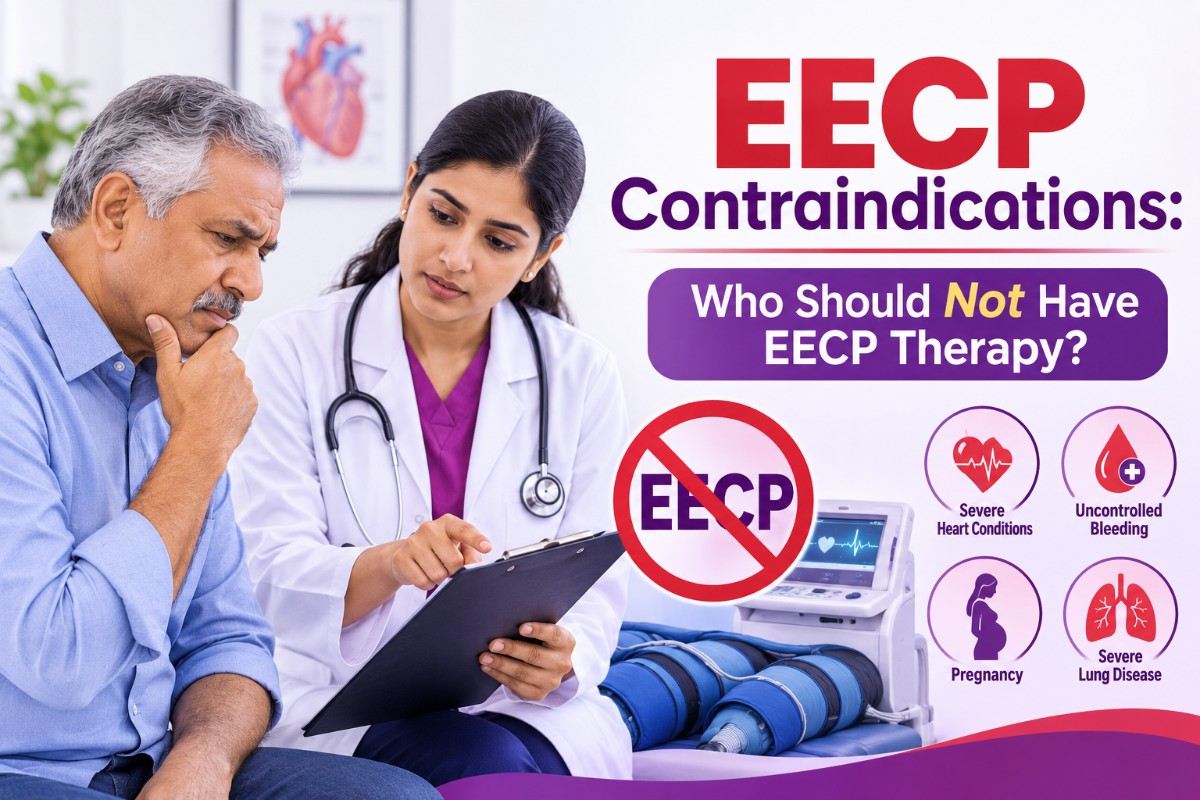
When people research EECP, most of what they find is about benefits. Far less is said about the other side of the question: who should not have it. That gap matters, because EECP is a therapy that squeezes the legs hard, in time with every heartbeat, and for some people that can do more harm than good.
This article is about exclusions only. If you want to know who may be a candidate, our eligibility guide covers that. Here we explain which conditions make EECP unsafe or unsuitable, which ones mean waiting, and why a proper screening before the first session is not a formality. Understanding EECP contraindications helps you ask better questions, and it helps you recognise a centre that takes safety seriously.
WHY EECP HAS CONTRAINDICATIONS
EECP uses cuffs wrapped around the calves, thighs and buttocks. They inflate in sequence while the heart is relaxing, then release just before it contracts, all timed to your ECG. This raises pressure in the aorta during relaxation, pushes more blood back to the heart, and reduces the effort the heart faces when it pumps.
That mechanism creates four kinds of risk for the wrong patient:
- It raises pressure inside the arteries during each cycle, which matters if blood pressure is already very high or if the aorta is weakened.
- It increases the amount of blood returning to the heart, which matters if the heart is already overloaded.
- It depends on a steady, readable heartbeat, which matters if the rhythm is irregular.
- It presses hard on the legs, which matters if there are clots, skin problems, fragile vessels or a tendency to bleed.
Every contraindication on the lists below traces back to one of those four ideas.
CONTRAINDICATION OR PRECAUTION? WHAT THE DIFFERENCE MEANS
Doctors use two overlapping terms:
- A contraindication means EECP should not be given while the condition is present. Examples include an active leg vein clot.
- A precaution means EECP may still be possible, but only with care, extra monitoring or after the problem is corrected. An example is blood pressure that is high but can be brought under control with medicine.
Many conditions can move from one category to the other. A temporary problem, such as a recent catheterisation or an uncontrolled blood pressure reading, may only mean waiting. A structural problem, such as a significant aortic aneurysm, may mean EECP is not appropriate at all.
CONDITIONS THAT COMMONLY RULE OUT OR DELAY EECP
| Condition | Why It Matters | Usual Approach |
|---|---|---|
| Significant Aortic Regurgitation (leaking aortic valve) | Blood can flow backward, and the therapy may not work as intended. | Generally avoided |
| Uncontrolled High Blood Pressure | The inflation cycle can increase blood pressure further. | Control blood pressure first; EECP may be considered once it is within acceptable limits. |
| Uncontrolled Arrhythmias (such as atrial fibrillation, flutter, ventricular tachycardia, or frequent extra beats) | The machine may fail to synchronize the cuffs with the heartbeat. | Generally avoided until the rhythm is controlled. |
| Very Fast Resting Heart Rate | Can interfere with treatment timing and may indicate an underlying instability. | Assess and correct the cause first. |
| Active Deep Vein Thrombosis (DVT) or Inflamed Veins | Compression may increase the risk of complications involving a blood clot. | EECP is generally avoided. |
| Aortic Aneurysm or Dissection | Increased aortic pressure may pose a risk. | Generally avoided; further evaluation is required if an aneurysm is suspected. |
| Bleeding Disorders or Excessive Anticoagulation | Cuff pressure may cause bruising or deeper bleeding. | Avoided or delayed until the condition is appropriately managed. |
| Unstable Angina or Recent Heart Attack | Requires urgent assessment and appropriate treatment before EECP. | Avoided until the patient is clinically stable. |
| Decompensated or Poorly Controlled Heart Failure | Increased blood return to the heart may worsen the condition. | Avoided until heart failure is stabilized. |
| Severe Peripheral Artery Disease, Leg Ulcers, or Skin Problems | Compression may injure fragile tissues or worsen existing problems. | Requires careful assessment; EECP may be avoided. |
| Pregnancy | Safety data are limited. | Generally avoided. |
| Recent Cardiac Catheterisation | There may be a risk of bleeding at the catheter insertion site. | Wait until the puncture site has adequately healed. |
| Recent Bypass Surgery or Stent Placement | Surgical wounds and catheter insertion sites may require additional healing time. | Treatment timing should be determined by the cardiologist. |
| Severe Lung Disease or Very Low Blood Pressure | The patient may not tolerate changes in circulation during treatment. | Requires individual clinical assessment. |
Important: Not every condition listed above is an absolute contraindication to EECP. The decision to proceed, delay, or avoid treatment depends on the patient’s medical condition, severity of symptoms, and the treating cardiologist’s assessment.
CAN EECP BE DONE WITH HIGH BLOOD PRESSURE?
It depends on how high and how well controlled. Because EECP raises pressure inside the arteries during each cycle, severe or uncontrolled hypertension is one of the best-recognised reasons to avoid it. Many protocols use a resting blood pressure of around 180/110 mmHg as a cut-off, although exact limits vary.
Two things are worth knowing. Mildly raised blood pressure that is treated and stable is not usually the same problem as severe, uncontrolled hypertension. And if your readings are high, the usual approach is to bring them under control with your doctor first, not to skip screening. Take your blood pressure medicines exactly as prescribed, and never change them just to meet a number.
EECP WITH AN IRREGULAR HEARTBEAT
EECP depends on the ECG to tell the machine when the heart is relaxing and when it is about to contract. If the rhythm is chaotic, the cuffs may inflate at the wrong moment, and the therapy could be ineffective or unsafe.
That is why uncontrolled atrial fibrillation, atrial flutter, ventricular tachycardia and frequent extra beats are commonly listed as reasons to avoid EECP, as is a very fast resting heart rate. It does not mean every person with an irregular rhythm is excluded. A well-controlled rhythm with a readable ECG trace is a different situation from an uncontrolled one, and your cardiologist will check this on your ECG before starting.
IS EECP SAFE AFTER A RECENT ANGIOGRAM, STENT OR BYPASS?
Recent procedures call for a pause. Manufacturer-derived guidance commonly lists a gap of about one to two weeks after cardiac catheterisation, to allow the puncture site in the wrist or groin to heal and to reduce the chance of bleeding. After bypass surgery, some guidance suggests waiting about three to six months, and after a stent, the waiting time depends on your recovery and your cardiologist’s judgement.
These are general ranges, not rules for you. The right timing depends on how your procedure went, where the access site was, what blood thinners you take and how you are healing. Ask your cardiologist directly: “When would it be safe for me to start?”
BLOOD THINNERS, BLEEDING AND LEG PROBLEMS
Blood thinners and bleeding
The cuffs apply firm pressure to large leg muscles. In people with a bleeding disorder, or whose blood is over-thinned, that pressure can lead to bruising or deeper bleeding in the muscle. For people on warfarin, doctors check the INR, and protocols differ on the acceptable upper limit. Never stop or reduce a blood thinner on your own in order to have EECP. Your cardiologist decides whether and how it can be managed.
Leg veins, arteries and skin
Active clots in the leg veins are a firm reason to avoid EECP, because compression could dislodge a clot. Severe narrowing of the leg arteries, leg ulcers and significant skin infections or breakdown also call for caution, since the cuffs could worsen them. Mention any leg pain, swelling, redness, wounds or varicose veins at your first visit.
The aorta
Because EECP raises pressure in the aorta, an aortic aneurysm or dissection is a serious concern. If an abdominal aortic aneurysm is suspected, it should be evaluated before treatment.
COMMON MISCONCEPTIONS
“I feel fine, so I do not need screening.” Several contraindications cause no symptoms at all. High blood pressure, a leaking valve and a silent clot can all go unnoticed.
“If I qualify at one centre, I qualify everywhere.” Thresholds and protocols differ, which is why each centre’s cardiologist must assess you.
“A contraindication is permanent.” Many are temporary, such as recent procedures or uncontrolled readings, and may resolve with treatment and time.
“Being turned down means no options.” It means EECP is not the right tool for you right now. Other treatments may still help.
“Age or diabetes automatically rules out EECP.” Age on its own is not usually the deciding factor in the guidance reviewed. The conditions above matter far more, and each patient is assessed individually.
HOW SCREENING WORKS BEFORE TREATMENT
A careful assessment usually covers:
- Your history: heart attacks, procedures, heart failure, rhythm problems, clots, bleeding, surgeries, pregnancy and all medicines
- Examination: blood pressure on more than one occasion, pulse, heart sounds, leg veins, skin and pulses
- A resting ECG to confirm rhythm and heart rate
- An echocardiogram, which helps check the valves, particularly the aortic valve, and heart function
- Blood tests where relevant, such as clotting tests if you take warfarin
- Review of recent reports, including angiograms and procedure dates
If anything looks like a contraindication, a responsible team will either explain why EECP is not advised or explain what needs to be corrected first.
WHAT IS MONITORED DURING TREATMENT
Screening does not end after the first session. Blood pressure, heart rate and rhythm are checked, the ECG and pulse waveform are watched, and skin is examined. Older guidance advises stopping therapy if certain events occur during the course, such as a heart attack, a sustained abnormal rhythm or an unstable angina pattern.
Tell your team promptly if you develop new chest pain at rest or an increasing pattern of chest pain, new breathlessness, leg swelling, calf pain, fever, unusual bruising, palpitations or skin damage. Do not wait for the next review.
IF EECP IS NOT SUITABLE FOR YOU
Hearing that EECP is not advised can be disappointing, particularly if you had hoped to avoid a procedure. But it is a safety decision, not a verdict on your options. Depending on your situation, your cardiologist may recommend adjusting medicines, correcting the underlying issue so that EECP can be reconsidered later, a repeat procedure or surgery where indicated, cardiac rehabilitation, or lifestyle and risk-factor control. Whatever the plan, keep taking your prescribed medicines and keep your follow-up appointments.
FREQUENTLY ASKED QUESTIONS
Who should not have EECP therapy?
People with conditions such as significant aortic regurgitation, uncontrolled high blood pressure or rhythm disorders, active leg vein clots, aortic aneurysm, bleeding problems, unstable angina, decompensated heart failure or pregnancy are commonly advised against it. A cardiologist must assess you.
Can EECP be done with high blood pressure?
Mild, well-controlled hypertension is different from severe, uncontrolled hypertension. Many protocols use about 180/110 mmHg as a cut-off, so high readings are usually controlled first.
Is EECP safe after a recent angiogram?
Usually only after a waiting period, often one to two weeks, so the puncture site can heal. Your cardiologist sets the timing for you.
Can I have EECP with atrial fibrillation or an irregular heartbeat?
Uncontrolled irregular rhythms can interfere with the machine’s timing and are commonly listed as reasons to avoid EECP. A well-controlled rhythm is assessed individually on ECG.
Can I have EECP if I take blood thinners?
It depends on the type, the dose and, for warfarin, your INR. Do not stop any blood thinner yourself. Your cardiologist decides how it should be managed.
Can I have EECP after a stent or bypass?
Often after sufficient healing time, which your cardiologist determines. Early after a procedure it is usually delayed.
Is EECP safe in heart failure?
Stable heart failure may be considered in selected patients, but poorly controlled or fluid-overloaded heart failure is a recognised reason to avoid it.
Can pregnant women have EECP?
No. EECP is avoided in pregnancy because safety data are lacking.
Do diabetes or older age rule out EECP?
Not by themselves. The specific conditions listed above matter more, and each patient is assessed individually.
Can a contraindication change over time?
Yes. Many are temporary and can improve with treatment, and EECP may be reconsidered later.
When Should You Consult a Cardiologist?
Arrange an assessment before starting EECP anywhere, and sooner if you notice:
- Chest tightness or pressure that is new, worsening or occurring at rest
- Breathlessness that is new or getting worse
- Palpitations, dizziness or fainting
- Leg swelling, calf pain or redness
- Unusual bruising or bleeding
- Blood pressure readings that stay high despite treatment
Seek emergency care immediately (call 108 or go to the nearest emergency department) for chest pain lasting more than a few minutes, pain spreading to the arm, jaw or back, severe breathlessness, cold sweats or fainting. Do not drive yourself.
SPEAKING WITH KGK HOSPITAL
KGK Hospital in Arumbakkam, Chennai, is a centre focused on EECP and non-invasive cardiac care. Dr. K G Krishnaraja, MD, founder and lead physician, reviews each patient’s history and tests before planning treatment, which includes checking whether EECP is appropriate at all. If you are unsure whether you might be excluded, the hospital offers a free initial consultation where you can discuss your conditions, medicines and reports.
KGK Hospital, Chennai: Poonamallee High Road, opposite Panchali Amman Koil Street, Arumbakkam, Chennai 600106
Hours: Monday to Sunday, 11:00 AM to 5:00 PM
Phone / WhatsApp: +91 94456 468 88
Email: kgkhospital@gmail.com
Conclusion
EECP can help some patients with angina, but it is not for everyone, and knowing who should avoid it is part of using it safely. The main concerns are conditions that make the extra pressure or return of blood dangerous, conditions that confuse the machine’s timing, and conditions that make leg compression risky. Many are temporary, and the exact limits depend on the protocol and your cardiologist’s judgement.
If you are considering EECP, get a proper cardiac assessment first, bring your reports and medicine list, and ask what would rule you out and what could be corrected. If you would like to talk this through, you are welcome to speak with a qualified cardiologist about your individual situation.
Disclaimer: This article is for general education and does not replace personal medical advice, diagnosis or treatment. Contraindication thresholds vary between protocols and centres. Treatment recommendations depend on an individual assessment by a qualified cardiologist.
Recent Posts
-
 EECP Contraindications: Who Should Not Have EECP Therapy?
-
 Chest Pain After Angioplasty or Bypass: Why It Can Happen and What to Do Next
-
 Exercise After a Heart Diagnosis: What Is Safe and What Isn't
-
 Heart-Healthy Diet Tips for Preventing Coronary Artery Disease
-
 Cholesterol and Heart Health: What Your Numbers Really Mean
Categories
- What is EECP? (Educational)
- EECP vs Surgery (Comparison)
- Heart Health Tips Diabetes & Heart Care
- Patient Stories
- EECP in Tamil (தமிழில் EECP)
- Doctor Articles & Expert Advice
Subscribe Newsletter
Signup our newsletter to get update information, news, insight or promotions.
