
EECP Session Duration & Schedule
EECP Treatment
Maecenas curae eu quis vehicula mus mattis blandit ullamcorper litora.
What is EECP?
EECP vs Other Treatments
Start Your Healing Journey Today!
Maecenas curae eu quis vehicula mus mattis blandit ullamcorper litora.
Start Your Healing Journey Today!
Maecenas curae eu quis vehicula mus mattis blandit ullamcorper litora.
EECP Session Duration and Treatment Schedule — What Chennai Patients Need to Know Before Starting
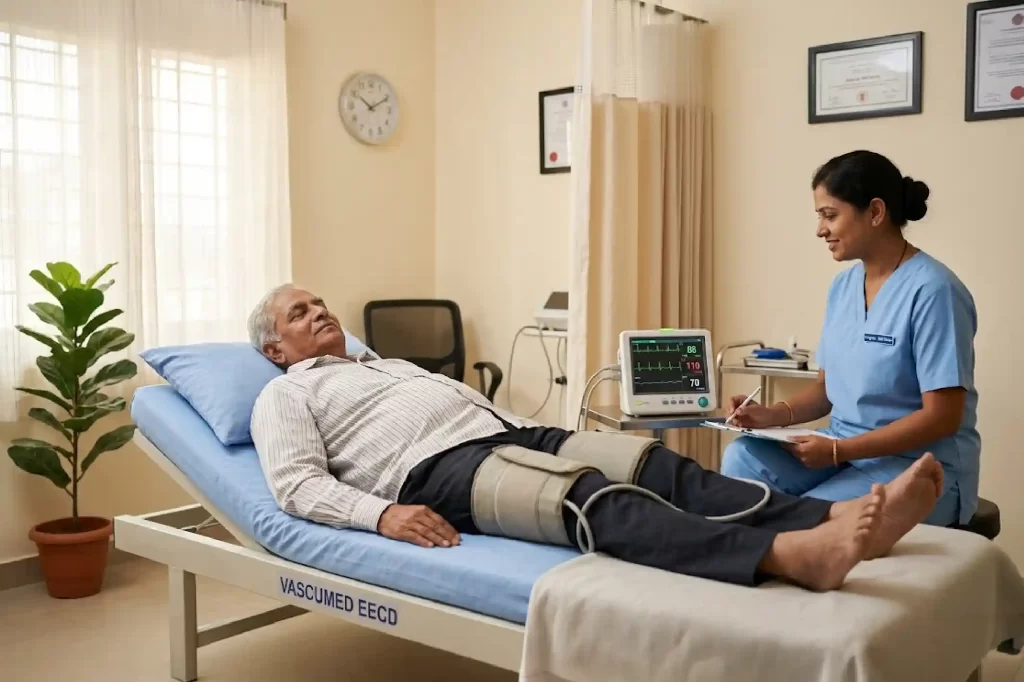
Before You Commit, You Want to Know How Long This Will Take
When a doctor recommends a course of treatment that spans several weeks, the first thing most patients think about is not just the treatment itself — it is their life around it. Will I have to take leave from work? Who will manage things at home? How many times a week do I need to come? These are practical, reasonable concerns, and they deserve clear answers.
For patients between 45 and 70 who are already managing a heart condition alongside family responsibilities and daily routines, knowing the full picture of what a treatment schedule looks like is not a small thing. It is often what decides whether someone moves forward or keeps postponing care they genuinely need.
The Standard EECP Session Duration and What the Schedule Looks Like
A complete course of EECP therapy consists of 35 sessions. Each session lasts approximately one hour. Sessions are typically scheduled five days a week, which means the full course runs over seven weeks. This schedule is based on established clinical protocols for Enhanced External Counterpulsation and is designed to allow the heart enough cumulative stimulation to develop meaningful improvements in blood flow.
The EECP session duration in Chennai at KGK Hospital is kept to a predictable one hour per visit — no waiting for anesthesia to wear off, no post-procedure observation time, and no overnight stay. You arrive, complete your session, and return to your regular day. Most patients find this structure far less disruptive than they initially expected.
Why the 35-Session Schedule Matters for Your Heart
The number and frequency of EECP sessions is not arbitrary. Each session builds on the previous one. The repeated mechanical stimulation of blood flow during EECP encourages the heart to develop collateral circulation — new small vessels that carry blood around narrowed or blocked coronary arteries. This process takes time and consistency, which is why missing sessions or spreading them out too thinly can reduce the effectiveness of the treatment.
Think of it the way you would think about physiotherapy after a joint injury. One or two sessions produce little result. A committed, regular course produces genuine recovery. For patients dealing with coronary artery disease, refractory angina, or reduced cardiac function, this consistency is what allows EECP to deliver its full therapeutic benefit. The schedule is designed to support your heart’s natural healing process rather than rush it.
Planning Your Seven Weeks — What the EECP Treatment Schedule Looks Like in Practice
Understanding how the EECP treatment schedule fits into real life helps patients plan ahead with confidence.
Week 1 and 2 are the adjustment phase. Your body is getting familiar with the treatment rhythm. Sessions are gentle and monitored closely. Most patients experience no disruption to their daily activities outside clinic hours.
Week 3 and 4 mark the early response phase for many patients. Chest pain frequency often begins to reduce. Energy levels during light activity may improve. This is when the cardiac rehabilitation effect starts to become noticeable.
Week 5 and 6 represent deeper therapeutic progress. Collateral vessel development is underway, and many patients report improved stamina and fewer episodes of breathlessness. Medication dependency for short-acting angina relief often reduces during this period for eligible patients.
Week 7 completes the course. Dr. Krishnaraja reviews your overall cardiac response and discusses the next phase of monitoring and care. For patients wondering about the financial planning involved across seven weeks, our EECP Session Packages and Pricing page provides a transparent breakdown of costs and available payment options.
Why Chennai Patients Trust KGK Hospital to Plan and Deliver Their EECP Schedule
At KGK Hospital in Arumbakkam, the EECP treatment schedule is built around the patient’s life — not just the clinical protocol. Dr. Krishnaraja understands that many patients travelling from Anna Nagar, Koyambedu, Kilpauk, or Nungambakkam are working professionals or older adults with family commitments. The clinic is open from Monday to Saturday from 09:00 AM to 5:00 PM, giving patients flexibility to choose session times that suit their mornings or afternoons without conflicting with work or family routines.
Each patient’s schedule is also reviewed individually. If a session needs to be rescheduled due to illness or an unavoidable commitment, the team works with you to keep the course on track without unnecessary gaps. This kind of practical, human flexibility is something that patients consistently find reassuring when they are committing to a seven-week treatment course.
The EECP session time and frequency at KGK Hospital are also supported by detailed progress monitoring. Dr. Krishnaraja does not simply run sessions in sequence — he reviews your cardiac response at regular intervals and adjusts the approach if needed. This active oversight is what makes the treatment feel genuinely personalized rather than routine.
For patients who want to understand what each session physically involves before committing to the schedule, our EECP Procedure page walks through the full experience in straightforward detail.
Scheduling Your First Visit Is a Simple, Low-Pressure Step
If the EECP session duration in Chennai sounds manageable and you want to understand whether this schedule works for your specific condition and lifestyle, a consultation at KGK Hospital is the place to begin. Call or reach the team on WhatsApp to book your appointment at Poonamallee High Road, Arumbakkam. The clinic is open Monday to Saturday, 09:00 AM to 5:00 PM. The first visit is purely a conversation — your reports are reviewed, your questions are answered, and you leave with a clear plan.
This page is intended for general informational purposes only and does not constitute medical advice. EECP treatment schedules and outcomes vary between patients, and individuals are advised to consult Dr. K G Krishnaraja or a qualified physician before beginning any cardiac treatment.
Frequently Asked Questions
What is your service?
Lorem ipsum dolor sit amet, consectetur adipiscing elit. Ut elit tellus, luctus nec ullamcorper mattis, pulvinar dapibus leo.
Where are you located?
Lorem ipsum dolor sit amet, consectetur adipiscing elit. Ut elit tellus, luctus nec ullamcorper mattis, pulvinar dapibus leo.
Wait. What is WordPress?
Lorem ipsum dolor sit amet, consectetur adipiscing elit. Ut elit tellus, luctus nec ullamcorper mattis, pulvinar dapibus leo.
- How We Work
You are capable of breaking free from negative thought patterns
Appointment
Dictum ornare torquent pretium litora risus odio vulputate feugiat amet
Consultation
Dictum ornare torquent pretium litora risus odio vulputate feugiat amet
Sessions
Dictum ornare torquent pretium litora risus odio vulputate feugiat amet
Evaluation
Dictum ornare torquent pretium litora risus odio vulputate feugiat amet
