
EECP Treatment Side Effects & Safety
EECP Treatment
Maecenas curae eu quis vehicula mus mattis blandit ullamcorper litora.
What is EECP?
EECP vs Other Treatments
Start Your Healing Journey Today!
Maecenas curae eu quis vehicula mus mattis blandit ullamcorper litora.
Start Your Healing Journey Today!
Maecenas curae eu quis vehicula mus mattis blandit ullamcorper litora.
EECP Treatment Side Effects and Safety — An Honest Guide for Heart Patients in Chennai
Asking About Side Effects Is the Smartest Thing You Can Do
Before starting any treatment for your heart, asking about risks is not pessimism — it is good judgment. Patients who ask these questions tend to make better decisions, stay more committed to their treatment, and experience less anxiety throughout the process. If you are researching EECP treatment side effects in Chennai and want a clear, honest answer rather than vague reassurance, this page is written to give you exactly that.
Many patients in the 50 to 70 age group come to this page after being told EECP is safe, but still wanting to understand what that actually means for someone their age, with their specific health history. That instinct is worth trusting.
What Makes EECP Inherently Different From Surgical Cardiac Procedures
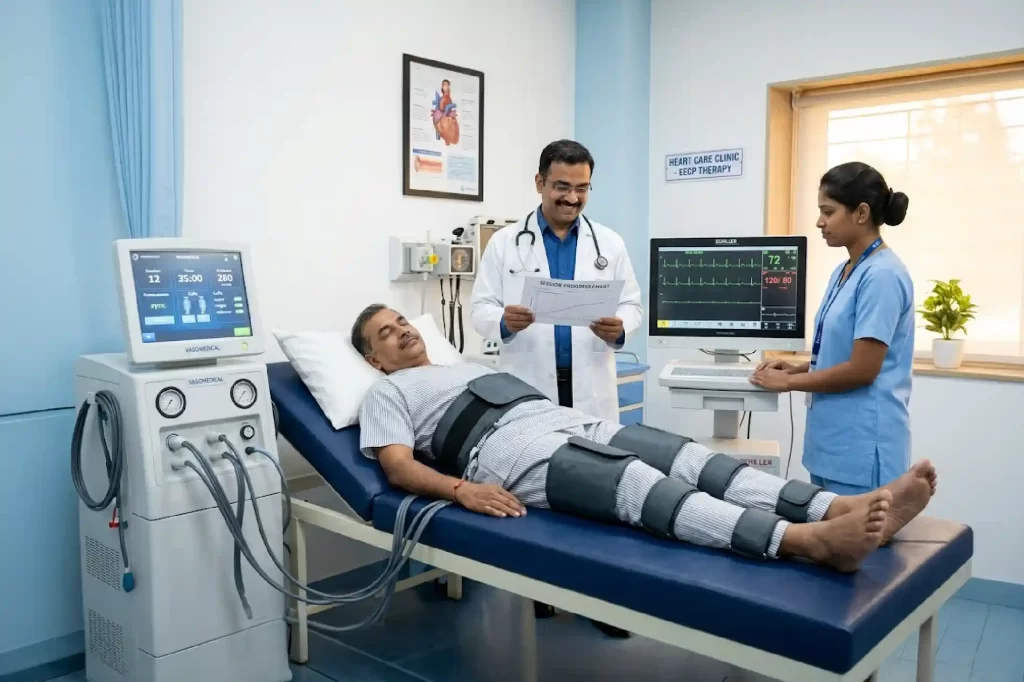
The reason EECP has a well-established safety profile is rooted in what the therapy does not involve. There is no surgery, no anesthesia, no incisions, and no insertion of any device into the body. The treatment works entirely from outside — through pressure cuffs placed on the legs that work in sync with the heartbeat to improve blood flow to the heart.
Because nothing enters the body, the category of risks associated with surgical procedures — infection, bleeding, anesthesia reactions, or complications during recovery — simply does not apply to EECP. This is one of the primary reasons EECP therapy is considered safe in Chennai and across international cardiac care guidelines, and why it has received FDA approval as a treatment for stable angina and coronary artery disease.
What EECP Treatment Side Effects Do Patients Actually Experience
For the majority of patients who complete a full course of EECP, the therapy is well tolerated with minimal discomfort. The most commonly reported experience is mild skin irritation or redness at the points where the cuffs contact the legs. This typically resolves on its own and can be managed with light padding during sessions if needed.
Some patients, particularly in the early sessions, notice mild muscle fatigue or a feeling of heaviness in the legs after treatment. This usually settles within the first week as the body adjusts to the therapy. A small number of patients with pre-existing skin sensitivity may experience slight bruising in the cuff areas, which is monitored and addressed by the clinical team. These are temporary and manageable responses — not indicators of harm. The EECP treatment risks associated with the therapy are low compared to the risks of leaving serious cardiac conditions unmanaged.
Is EECP Safe for Elderly Patients, Diabetics, and Those With Multiple Conditions
This is one of the most important questions patients ask, and the answer requires an honest, condition-specific assessment rather than a blanket statement.
EECP is generally considered suitable for elderly heart patients, including those above 60 and 70, precisely because it avoids the physical stress of surgery and anesthesia. For older patients whose bodies may not tolerate invasive procedures well, the non-surgical nature of EECP is a meaningful advantage.
For diabetic patients with cardiac complications, EECP can be appropriate but requires careful evaluation. Diabetes can affect skin integrity and circulation in the legs, so the treating physician assesses these factors before the course begins and monitors them throughout. Patients with diabetic cardiac conditions are not automatically excluded — they are assessed individually.
Patients with heart failure, reduced ejection fraction, or those who have previously undergone bypass surgery or stenting and continue to experience symptoms are also evaluated for EECP eligibility on a case-by-case basis. There are specific contraindications — such as uncontrolled arrhythmia, severe aortic insufficiency, or active deep vein thrombosis — where EECP would not be recommended. This is why a thorough consultation and review of cardiac reports is always the first step. To understand which conditions EECP is most commonly used for, our EECP Treatment Overview page provides a comprehensive reference.
Why Patients Across Anna Nagar and Chennai Feel Confident About Safety at KGK Hospital
At KGK Hospital on Poonamallee High Road, Arumbakkam, patient safety during EECP is not an assumption — it is an active process. Every patient undergoes a detailed pre-treatment assessment before the first session begins. Dr. Krishnaraja reviews your current cardiac reports, medication history, and any co-existing conditions to determine whether EECP is appropriate and how the sessions should be calibrated for your specific situation.
Throughout the 35-session course, each session is conducted under direct medical supervision using FDA-approved EECP equipment. The team monitors your heart rhythm continuously during treatment, and any unusual response is addressed immediately rather than noted and revisited later. This level of active oversight is what allows the clinic to safely treat patients with complex profiles — including elderly patients, diabetics, and those with post-surgical cardiac conditions.
Patients travelling from Anna Nagar, Kilpauk, Nungambakkam, and Koyambedu also find that the clinic’s consistent daily hours — Monday to Saturday, 09:00 AM to 5:00 PM — make it practical to attend sessions regularly without disrupting routines, which itself contributes to treatment safety by reducing gaps in the schedule. For patients who want to check whether their specific condition makes them a suitable candidate before visiting, our EECP Eligibility Checker is a useful starting point.
A Conversation About Safety Is the Best Way to Begin
If you still have specific questions about EECP treatment side effects in Chennai that relate to your own health history, a consultation with Dr. Krishnaraja is the most reliable way to get accurate, personalized answers. Call or reach the team on WhatsApp to schedule your visit at KGK Hospital, Poonamallee High Road, Arumbakkam. The clinic is open 6 days per week from 09:00 AM to 5:00 PM. The first consultation is a careful review of your condition — not a sales conversation — and you will leave with a clear, honest picture of whether EECP is right for you.
This page is intended for general informational purposes only and does not substitute for individualized medical advice. EECP treatment suitability and outcomes vary between patients, and individuals are strongly advised to consult Dr. K G Krishnaraja or a qualified physician before beginning any cardiac treatment.
Frequently Asked Questions
What is your service?
Lorem ipsum dolor sit amet, consectetur adipiscing elit. Ut elit tellus, luctus nec ullamcorper mattis, pulvinar dapibus leo.
Where are you located?
Lorem ipsum dolor sit amet, consectetur adipiscing elit. Ut elit tellus, luctus nec ullamcorper mattis, pulvinar dapibus leo.
Wait. What is WordPress?
Lorem ipsum dolor sit amet, consectetur adipiscing elit. Ut elit tellus, luctus nec ullamcorper mattis, pulvinar dapibus leo.
- How We Work
You are capable of breaking free from negative thought patterns
Appointment
Dictum ornare torquent pretium litora risus odio vulputate feugiat amet
Consultation
Dictum ornare torquent pretium litora risus odio vulputate feugiat amet
Sessions
Dictum ornare torquent pretium litora risus odio vulputate feugiat amet
Evaluation
Dictum ornare torquent pretium litora risus odio vulputate feugiat amet
