
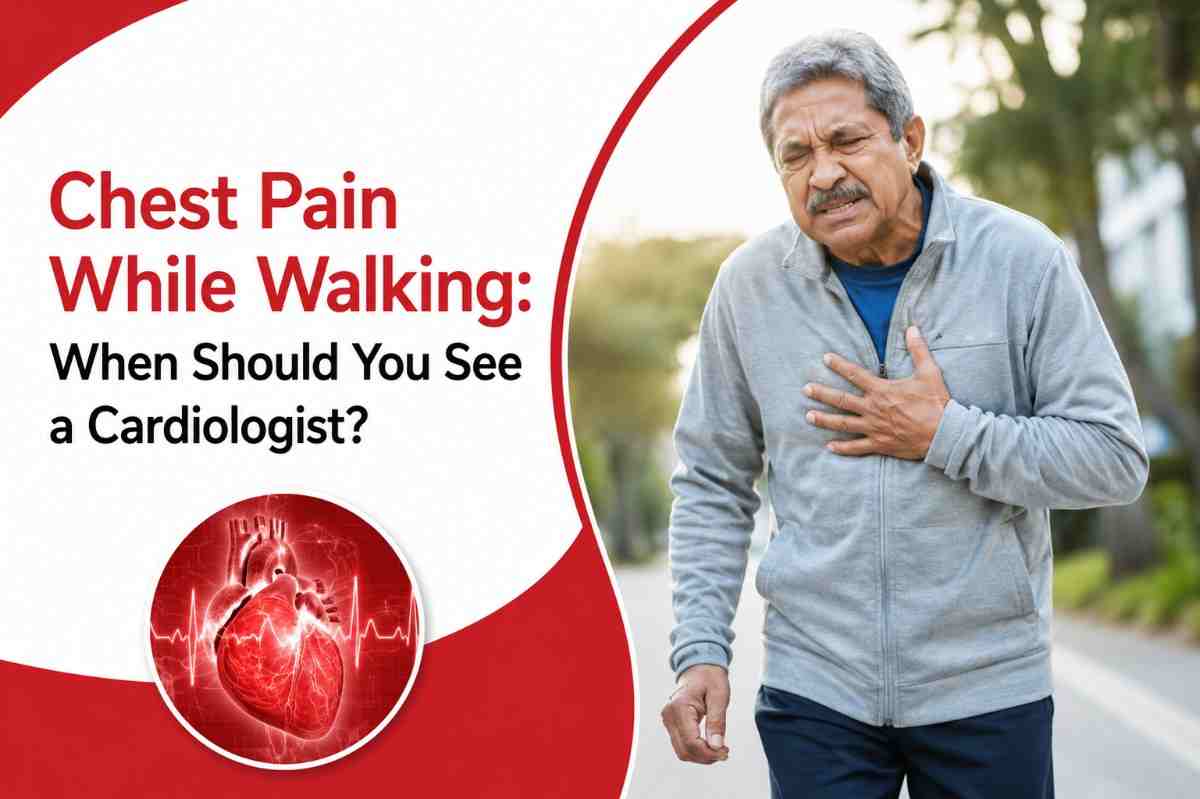
Chest Pain While Walking: When Should You See a Cardiologist?
Why Chest Pain During Walking Deserves Attention
Chest pain that shows up during a walk — whether it’s a brisk walk, a short uphill stretch, or even just a normal pace that suddenly feels harder than usual — is one of those symptoms that understandably makes people uneasy. Some people push through it and assume it’s nothing. Others panic at the first twinge. Neither response is quite right.
The reason this particular pattern of chest pain gets so much attention from cardiologists is that pain triggered specifically by exertion, and relieved specifically by rest, is one of the classic hallmarks of angina — chest discomfort caused by reduced blood flow to the heart muscle. That doesn’t mean every instance of chest pain while walking is cardiac, but it does mean this pattern is worth understanding clearly rather than dismissing or panicking over.
What Causes Chest Pain While Walking?
Chest pain during walking can come from several different sources, and telling them apart usually comes down to the pattern of the pain, not just its presence:
- Cardiac causes — most notably angina due to coronary artery disease, where the heart’s oxygen demand during exertion outpaces the blood supply available through narrowed arteries
- Musculoskeletal causes — strain in the chest wall muscles or cartilage, sometimes aggravated by posture or breathing during activity
- Gastrointestinal causes — acid reflux or indigestion, which can cause a burning chest sensation sometimes worsened by walking after a meal
- Respiratory causes — conditions affecting the lungs, such as asthma, which can cause chest tightness during exertion
- Anxiety-related causes — chest tightness or discomfort associated with stress or panic, which can occur during or independent of physical activity
The pattern of the pain, its relationship to exertion and rest, and any accompanying symptoms are what help a doctor distinguish between these possibilities — this is not something to self-diagnose based on internet searches alone.
Cardiac Causes: Understanding Angina
Angina occurs when narrowed coronary arteries can’t supply enough oxygen-rich blood to meet the heart’s increased demand during physical activity, such as walking, especially at a brisk pace or uphill. This creates a distinctive pattern:
- Pain or pressure typically begins during exertion, not before it
- It often eases within minutes of stopping or resting
- It may be triggered more easily in cold weather, after meals, or during emotional stress
- It can feel like pressure, tightness, squeezing, or heaviness, rather than a sharp, stabbing pain
- It may radiate to the arm, shoulder, neck, jaw, or back
This exertion-related pattern is often described clinically as “chest pain on exertion” and is one of the more reliable indicators that the cause may be cardiac, particularly in someone with risk factors for coronary artery disease.
Non-Cardiac Causes of Walking-Related Chest Pain
It’s worth being equally clear about patterns that suggest a non-cardiac cause, since not every twinge during a walk means heart trouble:
- Musculoskeletal pain often worsens with specific movements, deep breaths, or pressing on the chest wall, and isn’t necessarily linked to walking speed or intensity
- Reflux-related discomfort often has a burning quality, may worsen after eating or when lying down, and isn’t consistently tied to exertion
- Anxiety-related chest tightness can occur with or without walking, and is often accompanied by a racing heart, sweating, or a sense of panic unrelated to physical exertion level
- Brief, fleeting, sharp pains lasting only a second or two are less typical of angina, which tends to build and ease more gradually
That said, distinguishing these patterns reliably still benefits from a medical evaluation, especially if you have any risk factors for heart disease — self-diagnosis in either direction carries some risk.
Symptoms That Point Toward a Cardiac Cause
Alongside the chest pain itself, certain accompanying symptoms raise the likelihood of a cardiac cause and warrant prompt evaluation:
- Breathlessness that accompanies the chest discomfort
- Pain radiating to the arm, jaw, neck, or back
- Sweating, nausea, or lightheadedness alongside the pain
- Pain that reliably reproduces at a similar level of exertion each time
- Pain that’s new, or that’s becoming more frequent, severe, or triggered by less activity than before
If chest pain during walking is accompanied by any of these features, it should be treated as a priority for medical evaluation rather than something to monitor casually.
Risk Factors That Raise Concern
Chest pain during walking is more likely to be cardiac if you also have:
- High blood pressure or high cholesterol
- Diabetes or insulin resistance
- A history of smoking
- A family history of heart disease
- Obesity or a generally sedentary lifestyle
- Advancing age
- A personal history of a previous cardiac event or procedure
If you have one or more of these risk factors, chest pain that occurs specifically with walking should be evaluated sooner rather than later, even if it seems mild or infrequent.
How This Type of Chest Pain Is Diagnosed
A cardiologist evaluating chest pain during walking will typically use a combination of the following:
- Detailed symptom history — understanding exactly when the pain occurs, what triggers it, and what relieves it
- ECG — assessing the heart’s electrical activity, sometimes including an ECG taken during or shortly after exertion
- Stress testing — deliberately assessing how your heart performs under exertion, often the most directly relevant test for exertional chest pain
- Echocardiogram — imaging the heart’s structure and function
- Blood tests — checking cholesterol, blood sugar, and relevant cardiac markers
- Coronary angiography — direct imaging of the coronary arteries if a significant blockage is suspected
Stress testing is particularly useful here, since it can reproduce the exact circumstances — physical exertion — under which your symptoms occur, giving your cardiologist direct insight into what’s happening.
Treatment Options If Angina Is Confirmed
If your walking-related chest pain is confirmed to be angina from coronary artery disease, treatment is typically tailored to its severity and may include:
- Lifestyle modification — physical activity guidance, dietary changes, and smoking cessation
- Medications — such as nitrates, beta-blockers, calcium channel blockers, statins, and antiplatelet drugs
- EECP — a non-invasive therapy considered for chronic stable angina, particularly when symptoms persist despite medication
- Angioplasty with stenting — used for specific, significant blockages
- Bypass surgery — reserved for more extensive or complex disease
- Cardiac rehabilitation — a structured, supervised exercise and education program, often particularly relevant for patients whose main symptom is exertional chest pain
The right combination depends on the extent of your coronary artery disease, not on the chest pain alone.
When Might EECP Be Considered?
EECP, or Enhanced External Counterpulsation, is a non-invasive, FDA-approved therapy in which cuffs around the calves, lower thighs, and upper thighs inflate and deflate in sequence with the heartbeat, improving blood flow to the heart and encouraging collateral vessel development over the course of treatment.
A cardiologist may raise EECP as an option for patients whose walking-related chest pain (chronic stable angina) is:
- Persisting despite optimal medication
- Occurring in a pattern that limits daily activity, including walking itself
- Present in patients who are not ideal candidates for angioplasty or bypass surgery
- Continuing even after previous stenting or bypass surgery
As with any treatment decision, whether EECP is appropriate depends on a full cardiac evaluation, not on the symptom of exertional chest pain alone.
Benefits of Early Medical Evaluation
Chest pain during walking that keeps happening is not something to quietly work around by walking more slowly, avoiding inclines, or cutting activity short — patterns many patients adopt without realizing they’re compensating for a real underlying problem. Early evaluation identifies what’s actually causing the pain, so you’re not left guessing or unnecessarily limiting your activity out of caution.
If the cause turns out to be cardiac, early evaluation also means treatment can begin before the underlying coronary artery disease progresses further, often preserving access to less invasive treatment options.
Lifestyle Tips for Better Heart Health
Whether or not your walking-related chest pain turns out to be cardiac, these habits support long-term heart health:
- Stay physically active at a pace and intensity appropriate for your current health, as advised by your doctor
- Follow a heart-healthy diet — emphasizing vegetables, whole grains, and lean protein, while limiting saturated fat, added sugar, and excess salt
- Quit smoking and avoid tobacco, since it directly accelerates coronary artery disease
- Manage blood pressure, cholesterol, and blood sugar consistently
- Warm up gradually before brisk walking or exertion, and avoid sudden intense activity, especially in cold weather
- Track your symptoms — note what triggers the pain, how long it lasts, and what relieves it, and bring this information to your appointment
- Don’t push through pain during exertion — stop, rest, and seek evaluation rather than testing your limits repeatedly
Frequently Asked Questions
Why does my chest hurt when I walk fast but not when I walk slowly?
This pattern — pain appearing with increased exertion and easing with rest — is classic for angina, since faster walking increases the heart’s oxygen demand beyond what narrowed arteries can supply. It should be evaluated by a cardiologist.
Can chest pain during walking be something other than heart-related?
Yes. Musculoskeletal strain, acid reflux, and anxiety can all cause chest discomfort during walking. However, distinguishing these from cardiac causes reliably requires a medical evaluation, especially if you have heart disease risk factors.
Is it dangerous to keep walking through the pain?
It’s not advisable. If chest pain appears during walking, it’s safer to stop and rest rather than push through it, and to have the pattern evaluated by a doctor rather than repeatedly testing your limits.
How much chest pain during walking is considered serious?
Any chest pain that occurs predictably with exertion, especially if accompanied by breathlessness, radiating pain, sweating, or nausea, should be taken seriously and evaluated promptly, regardless of how mild it seems.
What tests will a cardiologist use to figure out the cause?
Commonly, an ECG, stress test, echocardiogram, and blood tests are used initially, with coronary angiography reserved for cases where a significant blockage is suspected.
When Should You Consult a Cardiologist?
Schedule a cardiology evaluation if you experience:
- Chest pain, pressure, or tightness that occurs during walking or other exertion
- Pain that eases with rest but returns with similar activity
- Breathlessness accompanying the chest discomfort
- Discomfort radiating to the arm, jaw, neck, or back during exertion
- Chest pain that’s new, more frequent, or triggered by less activity than before
- Known risk factors such as diabetes, high blood pressure, or a family history of heart disease
If you experience sudden, severe chest pain, chest pain with sweating or nausea, pain spreading to the arm or jaw, or sudden severe breathlessness — whether at rest or during activity — this may be a medical emergency. Seek immediate emergency medical care rather than waiting for a scheduled appointment.
Why Choose KGK Hospital
KGK Hospital in Arumbakkam, Chennai, focuses specifically on EECP therapy and non-invasive cardiac care, under the guidance of Dr. K G Krishnaraja. Because exertional chest pain and chronic stable angina are a core part of the hospital’s clinical focus, the team is experienced in carefully evaluating this specific symptom pattern rather than treating it as a routine complaint.
Every evaluation at KGK Hospital begins with a detailed review of when and how your chest pain occurs, your risk factors, and your overall health, so that any recommendation — whether further testing, lifestyle guidance, medication, or EECP — is based on your actual clinical picture. The hospital is located on Poonamallee High Road, Arumbakkam, accessible from Anna Nagar and surrounding parts of Chennai, making it a practical option for patients in the area seeking evaluation for exertional chest pain.
Conclusion
Chest pain that shows up specifically while walking isn’t something to dismiss, and it isn’t something to panic over either — it’s a pattern that deserves a clear answer. The exertion-and-rest pattern that defines angina is genuinely distinct from musculoskeletal, digestive, or anxiety-related chest discomfort, but telling them apart reliably takes proper evaluation, not guesswork.
If chest pain has been showing up during your walks, don’t quietly adjust your pace and hope it goes away — get it evaluated. Consider speaking with a cardiologist at KGK Hospital, Arumbakkam, Chennai, to understand what’s causing your symptoms and what your options are.

About Author
At placerat eleifend nulla inceptos per dolor lacinia posuere. Rhoncus sociosqu dolor pharetra torquent interdum curabitur erat pellentesque.
Share Post :




Categories
- What is EECP? (Educational)
- EECP vs Surgery (Comparison)
- Heart Health Tips Diabetes & Heart Care
- Patient Stories
- EECP in Tamil (தமிழில் EECP)
- Doctor Articles & Expert Advice
Subscribe Newsletter
Signup our newsletter to get update information, news, insight or promotions.
