
EECP Therapy Cost in Chennai: What Determines the Price?
Introduction
If you’re researching EECP cost in Chennai, you’ve probably already learned a bit about the treatment and are now trying to figure out what it will actually cost you. That’s a completely reasonable thing to want clarity on before committing to any course of therapy, especially one that involves multiple sessions over several weeks.
The honest answer is that EECP pricing isn’t one-size-fits-all. It depends on your specific condition, the number of sessions your cardiologist recommends, and the hospital you choose. This article walks through what typically drives the cost of EECP therapy, what’s usually included in that cost, and how to get a reliable, personalized estimate rather than relying on a generic number you might see online.
What Is EECP Therapy?
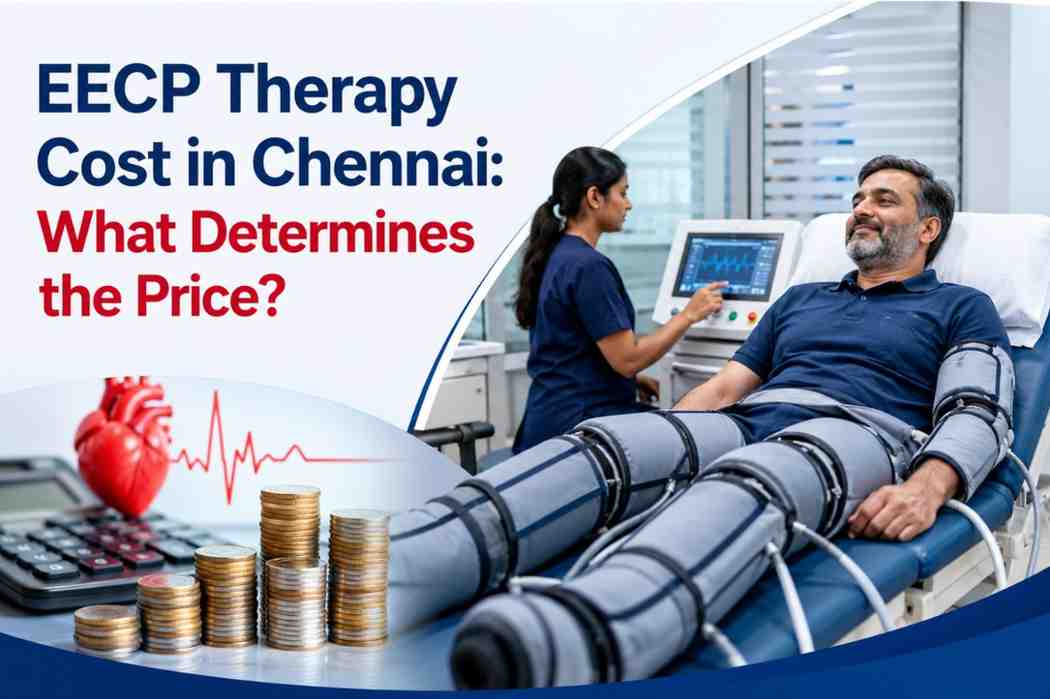
EECP is a non-invasive, outpatient treatment that uses inflatable cuffs wrapped around the calves, thighs, and buttocks. These cuffs inflate and deflate in coordination with your heartbeat, guided by ECG monitoring, to improve blood flow to the heart during its resting phase and reduce the workload on the heart during contraction.
A full course typically involves around 35 one-hour sessions spread over roughly seven weeks, though the exact number can vary based on how a patient responds and what their cardiologist recommends.
Why Cost Varies From Patient to Patient
Two patients considering EECP at the same hospital may end up with different costs, and that’s normal. The reasons include:
- Number of sessions needed — Some patients require the full standard course, while others may need a modified number based on their response and condition.
- Diagnostic workup required beforehand — Tests like ECG, echocardiogram, or stress testing may be needed to confirm candidacy, and these add to the overall cost.
- Severity and complexity of the underlying heart condition — More complex cases may require closer monitoring or additional evaluation during treatment.
- Package inclusions — Some hospitals bundle pre-treatment assessments and follow-up visits into the total price, while others charge separately.
What Typically Influences EECP Pricing
Across hospitals in India, a few consistent factors affect the final price:
- Hospital infrastructure and equipment — Facilities using advanced, well-maintained EECP systems may price differently than smaller clinics.
- Cardiologist and technical team expertise — Experienced teams overseeing the therapy can affect cost.
- City and location — Costs in metro cities like Chennai can differ from smaller towns.
- Session count — Shorter packages (for example, 12–20 sessions) typically cost less than a full 35-session course, though this depends on clinical need rather than preference.
- Insurance coverage — Most standard health insurance policies in India do not currently cover EECP, so this is usually an out-of-pocket cost. It’s worth checking directly with your insurer, as policies do change.
Published figures for a full EECP course across various Indian hospitals depending on all the factors above. Given this range, the only reliable way to know your actual cost is to get a personalized quote after a consultation.
What a Full Course of EECP Usually Involves
A typical EECP treatment plan includes:
- Initial consultation and evaluation — Review of your medical history and symptoms
- Diagnostic testing — ECG, echocardiogram, and possibly a stress test to confirm suitability
- The EECP sessions themselves — Usually 35 one-hour sessions, five days a week, over about seven weeks
- Monitoring throughout treatment — Regular check-ins to track your response
- Post-treatment follow-up — Reassessment of symptoms and overall progress
Understanding what’s included helps you compare quotes meaningfully rather than just looking at a single number.
Who Might Benefit From EECP?
EECP is generally considered for patients who:
- Have chronic stable angina that continues despite medication
- Are not ideal candidates for angioplasty or bypass surgery
- Have already had angioplasty or bypass but still experience symptoms
- Prefer to explore non-invasive treatment options in consultation with their cardiologist
Suitability isn’t something to self-determine — it requires a proper cardiac evaluation, since certain conditions like uncontrolled arrhythmias or significant leg vascular disease can affect candidacy.
Diagnosis Before Starting EECP
Before recommending EECP, your cardiologist will typically review:
- Your symptom history and severity
- Results from an ECG and echocardiogram
- Stress test results, where applicable
- Any prior cardiac procedures you’ve had
- Other health conditions that might affect treatment suitability
This evaluation is also what allows the hospital to give you an accurate cost estimate, since the number of sessions and any additional testing depend on these findings.
Is Cheaper Always Better?
It’s tempting to choose the lowest quoted price, but cost shouldn’t be the only factor in your decision. Consider also:
- Whether the facility uses properly maintained, FDA-cleared EECP equipment
- The experience of the cardiology team overseeing your sessions
- Whether ECG monitoring and emergency protocols are in place during sessions
- Genuine patient reviews and outcomes, not just promotional claims
A lower price that skips proper monitoring or evaluation isn’t a good trade-off when it comes to your heart health.
Benefits of Early Medical Evaluation
Getting evaluated sooner rather than later gives you a clearer picture of both your treatment options and their associated costs. Early evaluation can help you:
- Understand whether EECP is even appropriate for your condition
- Get an accurate, personalized cost estimate rather than guessing from online figures
- Explore financing or package options before your condition potentially worsens
- Make a well-informed decision without time pressure
Lifestyle Tips for Better Heart Health
Alongside any treatment you pursue, these habits support better long-term outcomes:
- Eat a heart-healthy diet low in saturated fat, salt, and added sugar
- Stay physically active within limits approved by your doctor
- Maintain a healthy weight
- Quit smoking
- Manage stress through sleep, relaxation, or counseling
- Take prescribed medications consistently
- Attend regular follow-ups to monitor cholesterol, blood pressure, and blood sugar
Frequently Asked Questions
1. How much does EECP cost in Chennai?
Costs vary by hospital and individual case. It’s best to get a personalized quote after a consultation rather than relying on a general figure.
2. Does the cost include diagnostic tests?
This depends on the hospital’s package structure. Some bundle pre-treatment tests into the total cost, while others charge separately — ask for a clear breakdown.
3. Is EECP cheaper than angioplasty or bypass surgery?
EECP is generally reported as more affordable than invasive procedures, but the appropriate treatment depends on your diagnosis, not price comparison.
4. Does insurance cover EECP?
Most standard health insurance policies in India do not currently cover EECP. Check directly with your insurer for the most current information.
5. Can the number of sessions affect the total cost?
Yes. Shorter courses may cost less, but the number of sessions should be determined by clinical need, not cost preference.
6. Are there hidden costs I should ask about?
Ask specifically whether the quoted price includes consultations, diagnostic tests, and follow-up visits, or if these are billed separately.
7. Is a lower-cost EECP provider necessarily worse?
Not necessarily, but you should verify that the facility uses proper equipment, has ECG monitoring during sessions, and has qualified staff overseeing treatment.
8. Can I get a cost estimate without committing to treatment?
Yes, most hospitals will provide an estimate after an initial consultation and evaluation, before you commit to starting sessions.
9. Does EECP cost more if I've already had a stent or bypass?
Not directly, though your specific treatment plan and number of sessions may vary based on your cardiac history, which can affect the total.
10. How can I get an accurate cost for my situation?
The most reliable way is to schedule a consultation where your cardiologist can review your condition and provide a personalized estimate.
When Should You Consult a Cardiologist?
Consider scheduling a consultation if you experience:
- Ongoing chest discomfort, especially during exertion
- Shortness of breath during everyday activities
- Fatigue that seems disproportionate to your activity level
- A history of heart disease and no recent evaluation
Seek emergency care immediately if you experience sudden, severe chest pain, pain radiating to the arm or jaw with sweating or nausea, or sudden shortness of breath — these require urgent attention, not a scheduled consultation.
Why Choose KGK EECP Hospital?
KGK EECP Hospital in Anna Nagar, Chennai, offers dedicated cardiology care with a focus on non-surgical treatments, including EECP therapy. The team works with each patient to review their condition, explain what a recommended treatment plan would involve, and provide a clear, personalized cost estimate based on their specific evaluation — rather than a generic figure.
Patients considering EECP can request a consultation to understand both their treatment options and an accurate cost breakdown tailored to their situation.
Conclusion
EECP therapy costs depend on several factors — the number of sessions, diagnostic requirements, and the hospital you choose — so it’s difficult to give one universal number that applies to everyone. Rather than basing your decision on a figure you found online, the most reliable approach is a consultation where a cardiologist can assess your condition and give you a clear, accurate estimate.
If you’re exploring EECP as an option for managing your heart condition, consider scheduling an evaluation to get both a clinical assessment and a personalized cost breakdown.

About Author
At placerat eleifend nulla inceptos per dolor lacinia posuere. Rhoncus sociosqu dolor pharetra torquent interdum curabitur erat pellentesque.
Share Post :
Recent Posts
-
 Heart-Healthy Diet Tips for Preventing Coronary Artery Disease
 -
 Cholesterol and Heart Health: What Your Numbers Really Mean
 -
 High Blood Pressure and Heart Disease: Understanding the Risk
 -
 Diabetes and Heart Disease: Why Early Prevention Matters
 -
 Living with Heart Failure: Management Options Beyond Medication
Categories
- What is EECP? (Educational)
- EECP vs Surgery (Comparison)
- Heart Health Tips Diabetes & Heart Care
- Patient Stories
- EECP in Tamil (தமிழில் EECP)
- Doctor Articles & Expert Advice
Subscribe Newsletter
Signup our newsletter to get update information, news, insight or promotions.
Subscribe Newsletter
Signup our newsletter to get update information, news, insight or promotions.
