
Can EECP Help Avoid Repeat Angioplasty? What Patients Should Know
Introduction
If you’ve already had an angioplasty and you’re now dealing with chest pain again, or your doctor has mentioned the possibility of another procedure, it’s completely understandable to want to know if there’s another way forward. This is one of the most common questions we hear from patients who’ve been through the stent experience once and would rather avoid going through it again if possible.
That’s where the comparison of EECP vs angioplasty usually comes up. EECP is a non-invasive therapy that some patients explore, either as a way to manage symptoms without another procedure, or alongside their existing treatment plan. This article explains how EECP works, how it’s different from angioplasty, and what factors your cardiologist will consider in deciding whether it’s a reasonable option for you.
Understanding Angioplasty and Why It's Sometimes Repeated
Angioplasty (percutaneous coronary intervention, or PCI) is a procedure where a catheter is used to open a narrowed or blocked coronary artery, usually followed by placement of a stent to keep the artery open. It’s highly effective for relieving blockages, especially in urgent situations like a heart attack.
However, angioplasty treats the blockage at the time of the procedure — it doesn’t stop new blockages from forming elsewhere, and in some cases, the treated area itself can narrow again over time, a process called restenosis. This is why some patients end up needing a second or even third procedure years later, particularly if underlying risk factors like cholesterol or blood sugar aren’t well controlled.
What Causes Recurring Blockages?
Several factors can contribute to new or returning blockages after an initial angioplasty:
- Continued plaque buildup in other areas of the coronary arteries
- Restenosis, where scar tissue or plaque narrows the previously treated segment
- Poorly controlled cholesterol, blood pressure, or blood sugar
- Ongoing smoking
- Lack of adherence to prescribed medications
- Progression of underlying coronary artery disease despite treatment
Symptoms That Suggest a Blockage May Be Returning
Patients who’ve had a prior angioplasty should be alert to symptoms such as:
- Chest discomfort or tightness returning, especially with exertion
- Shortness of breath that wasn’t there before or has worsened
- Unusual fatigue during activities that were previously manageable
- Discomfort in the jaw, arm, neck, or back
- Palpitations or lightheadedness
These symptoms don’t automatically mean the stent has failed, but they do warrant prompt evaluation.
Who Is at Higher Risk of Needing Repeat Angioplasty?
Certain patients are statistically more likely to need a repeat procedure:
- Those with diabetes, which is associated with higher rates of restenosis
- Patients with multiple coronary arteries affected (multi-vessel disease)
- Individuals who continue smoking after their first procedure
- Patients with poorly controlled cholesterol or blood pressure
- Those who don’t consistently take prescribed antiplatelet or statin medications
- People with a strong family history of coronary artery disease
How Is a Recurring Blockage Diagnosed?
If symptoms return after angioplasty, your cardiologist may use several tools to assess what’s happening:
- ECG: To check for changes in the heart’s electrical activity
- Echocardiogram: To evaluate how well the heart is pumping
- Stress Test: To see how the heart performs under exertion
- CT Coronary Angiography: For detailed, non-invasive imaging of the arteries
- Invasive Coronary Angiography: The most definitive way to visualize whether the stent or other arteries are narrowing again
The specific combination of tests depends on your symptoms, prior history, and your cardiologist’s clinical judgment.
Treatment Options After Angioplasty
When symptoms return after a prior procedure, there are usually several paths to consider, often used in combination:
Optimized medical therapy — Adjusting or intensifying medications such as statins, antiplatelet drugs, or anti-anginal medications is often the first step.
Lifestyle changes — Diet, exercise, weight management, and smoking cessation remain foundational, regardless of how many procedures a patient has had.
Repeat Angioplasty — May be recommended if imaging shows a significant blockage that’s causing symptoms or putting the patient at risk.
Bypass Surgery (CABG) — Considered in cases of extensive multi-vessel disease or when angioplasty isn’t a safe or effective option.
EECP — May be considered for patients with persistent angina despite optimized medication, particularly those who are not ideal candidates for another invasive procedure, or who wish to explore non-invasive options in consultation with their doctor.
Cardiac Rehabilitation — A structured program that supports recovery and helps reduce the risk of future events, regardless of which other treatments are used.
What Is EECP and How Does It Work?
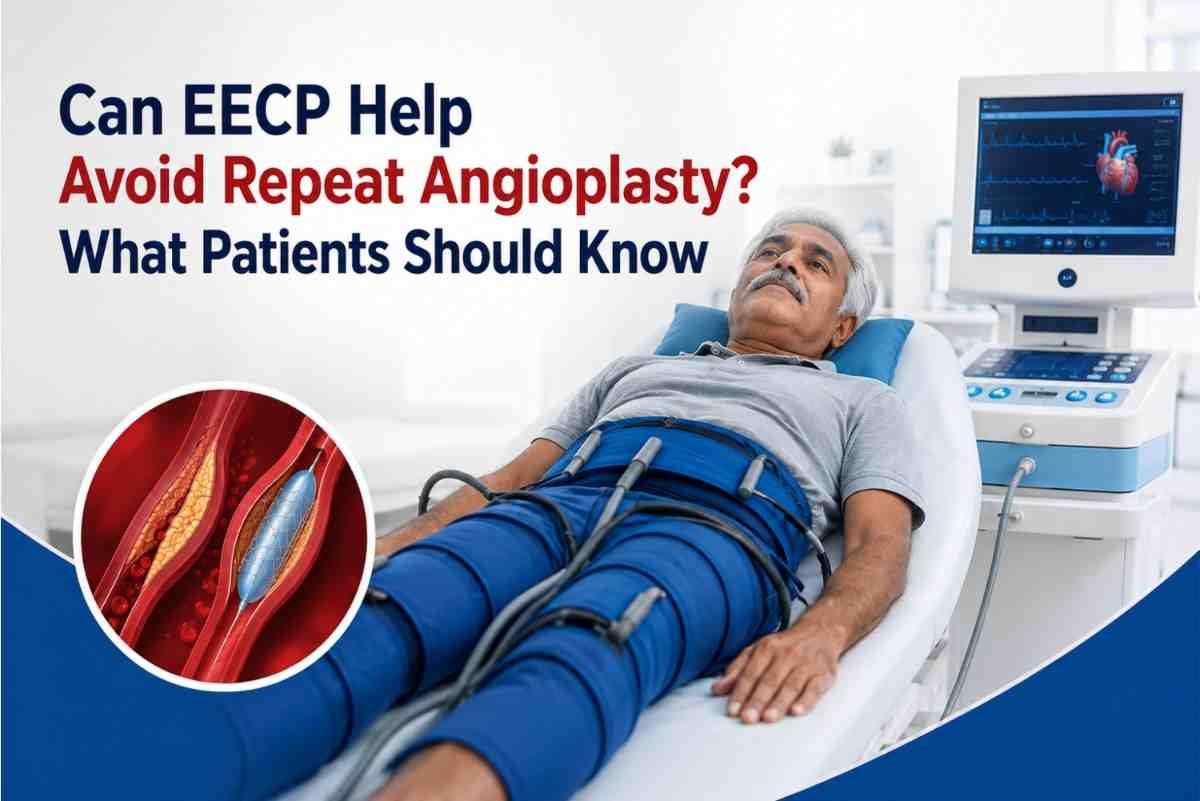
EECP, or Enhanced External Counterpulsation, is a non-invasive, outpatient therapy that uses inflatable cuffs wrapped around the calves, lower thighs, and upper thighs. These cuffs inflate and deflate in sync with your heartbeat, guided by ECG monitoring.
During the heart’s relaxation phase (diastole), the cuffs inflate in sequence from the legs upward, pushing blood back toward the heart at the moment it can best use the extra flow. During contraction (systole), the cuffs release rapidly, reducing the workload on the heart.
A typical course involves 35 one-hour sessions over about seven weeks. Over time, this repeated action is thought to promote the development of small collateral vessels around narrowed arteries and improve blood vessel function, which may help reduce angina frequency for some patients.
EECP vs Angioplasty: How They Compare
Factor | Angioplasty (PCI) | EECP |
Type of procedure | Invasive (catheter-based) | Non-invasive (external) |
Purpose | Mechanically opens a blocked artery | Improves blood flow and may reduce angina symptoms |
Typical use | Significant blockages, urgent situations, acute heart attacks | Chronic stable angina, especially when other options aren’t suitable |
Recovery | Short hospital stay, brief recovery period | No hospital stay; outpatient sessions over several weeks |
Repeat risk | Restenosis possible in treated segment | Not a mechanical fix; addresses symptoms and circulation |
Candidacy | Determined by angiogram findings and symptom severity | Determined by cardiologist evaluation, ruling out contraindications |
These two treatments generally serve different purposes rather than competing directly. Angioplasty addresses a specific blockage that needs to be physically opened, while EECP is typically used to help manage ongoing angina symptoms, especially when repeat intervention isn’t the best option for a given patient.
When Might EECP Be Considered After Angioplasty?
EECP may be worth discussing with your cardiologist if you:
- Continue to experience angina despite optimized medication after a prior angioplasty
- Have diffuse coronary artery disease that isn’t well suited to another stent or bypass
- Are not a good candidate for repeat angioplasty or surgery due to other health conditions
- Want to explore a non-invasive option before considering another procedure
EECP is generally not appropriate as a substitute for urgent revascularization if imaging shows a blockage that’s causing unstable symptoms or putting you at immediate risk — in those cases, timely intervention remains important. Your cardiologist will also check for conditions like uncontrolled arrhythmias, significant leg vascular disease, or uncontrolled high blood pressure, which can affect EECP candidacy.
Benefits of Early Medical Evaluation
Getting evaluated as soon as new or returning symptoms appear gives you and your cardiologist the most options to work with. Early evaluation can help:
- Determine whether a blockage is progressing before it becomes urgent
- Identify whether medication adjustments alone might resolve symptoms
- Clarify whether EECP, repeat angioplasty, or another approach fits your situation
- Reduce the chances of an emergency situation later on
Lifestyle Tips for Better Heart Health
Regardless of which treatments you and your cardiologist choose, these habits support long-term outcomes:
- Follow a heart-healthy diet low in saturated fat, salt, and added sugar
- Stay physically active within limits approved by your doctor
- Maintain a healthy body weight
- Quit smoking completely
- Manage stress through sleep, relaxation, or counseling support
- Take all prescribed medications consistently and as directed
- Attend regular follow-up appointments to monitor cholesterol, blood pressure, and blood sugar
Frequently Asked Questions
1. Can EECP completely replace the need for angioplasty?
Not necessarily. The two treatments generally serve different purposes, and a cardiologist can advise whether EECP is appropriate for your specific case or whether angioplasty is still needed.
2. Is EECP safe for patients who already have a stent?
Many patients with prior stents undergo EECP, but candidacy depends on individual evaluation by a cardiologist.
3. How long does it take to see results from EECP?
Response varies. Some patients notice reduced angina partway through treatment, while others see improvement closer to the end of the full course.
4. Does EECP prevent restenosis in a stent?
EECP does not act directly on stent tissue. It’s aimed at improving overall blood flow and symptoms, not preventing restenosis specifically.
5. What happens if EECP doesn't relieve my symptoms?
If symptoms persist or worsen, your cardiologist will reassess and may recommend other options, including repeat angioplasty or further testing.
6. Is EECP painful?
Most patients describe a firm squeezing sensation in the legs rather than pain.
7. Can I do EECP if I'm still on blood thinners after my stent?
This depends on your specific medications and health status — your cardiologist will review this before recommending EECP.
8. How many EECP sessions are typically needed?
A standard course is usually 35 sessions, one hour each, over roughly seven weeks.
9. Will my cardiologist recommend EECP instead of testing for restenosis?
No — if there’s a concern about restenosis or a new blockage, appropriate diagnostic testing comes first. EECP is considered based on those results, not as a substitute for them.
10. Is EECP covered by insurance?
Coverage varies by insurer. It’s best to confirm directly with your insurance provider and the hospital’s billing office.
When Should You Consult a Cardiologist?
Reach out to a cardiologist if you notice:
- Chest discomfort returning after a prior angioplasty
- New shortness of breath during routine activity
- Fatigue that feels disproportionate to your usual activity level
- Any symptom your doctor previously told you to watch for after your procedure
Seek emergency care immediately if you experience sudden, severe chest pain, pain radiating to the arm or jaw with sweating or nausea, or sudden difficulty breathing — these can indicate a heart attack and need urgent attention rather than a scheduled visit.
Why Choose KGK EECP Hospital?
KGK EECP Hospital in Anna Nagar, Chennai, focuses on non-surgical cardiology care, including EECP therapy for patients managing chronic angina. The team works with each patient to review their prior treatment history — including previous angioplasty or bypass — and discuss whether EECP fits appropriately into their ongoing care plan.
Patients who continue to experience symptoms after a prior procedure, or who are exploring non-invasive options before considering another intervention, can request a consultation to go over their test results and treatment history in detail.
Conclusion
Dealing with recurring symptoms after an angioplasty can be frustrating, especially if the idea of another procedure feels daunting. EECP offers a non-invasive option that some patients use to help manage ongoing angina, particularly when repeat intervention isn’t the most suitable next step. That said, it isn’t a direct substitute for angioplasty when a blockage genuinely requires mechanical treatment.
The best way to know which path makes sense for you is a detailed conversation with your cardiologist, who can review your imaging, symptoms, and treatment history together. If you’re weighing your options after a prior angioplasty, consider scheduling an evaluation to discuss whether EECP has a role in your care.

About Author
At placerat eleifend nulla inceptos per dolor lacinia posuere. Rhoncus sociosqu dolor pharetra torquent interdum curabitur erat pellentesque.
Share Post :
Recent Posts
-
 Heart-Healthy Diet Tips for Preventing Coronary Artery Disease
 -
 Cholesterol and Heart Health: What Your Numbers Really Mean
 -
 High Blood Pressure and Heart Disease: Understanding the Risk
 -
 Diabetes and Heart Disease: Why Early Prevention Matters
 -
 Living with Heart Failure: Management Options Beyond Medication
Subscribe Newsletter
Signup our newsletter to get update information, news, insight or promotions.
Categories
- What is EECP? (Educational)
- EECP vs Surgery (Comparison)
- Heart Health Tips Diabetes & Heart Care
- Patient Stories
- EECP in Tamil (தமிழில் EECP)
- Doctor Articles & Expert Advice
Subscribe Newsletter
Signup our newsletter to get update information, news, insight or promotions.
