
Common Myths About EECP Therapy Debunked
Why EECP Myths Spread So Easily
If you’ve been told you have heart blockage, angina, or coronary artery disease, and someone has mentioned EECP as an option, chances are you’ve also come across at least one alarming claim about it — that it’s painful, that it doesn’t really work, that it’s only for patients who have “given up” on other treatments, or the opposite extreme, that it can replace surgery for anyone.
Cardiac therapies tend to attract this kind of confusion for a simple reason: patients researching heart treatment are often anxious, and anxiety makes half-true information spread faster than it should. Add in outdated blog posts, decade-old forum threads, and content written without clinical input, and it’s easy to see how myths about EECP therapy have taken root.
As a team that works with EECP patients directly, we think the most useful thing we can do is walk through the most common myths in plain language, explain what current cardiology guidance actually says, and be honest about where EECP is genuinely useful — and where it isn’t.
What Is EECP Therapy?
EECP, or Enhanced External Counterpulsation, is a non-invasive, FDA-approved treatment used mainly for chronic stable angina and, in some cases, heart failure with reduced ejection fraction, particularly in patients who haven’t found adequate relief through medication alone.
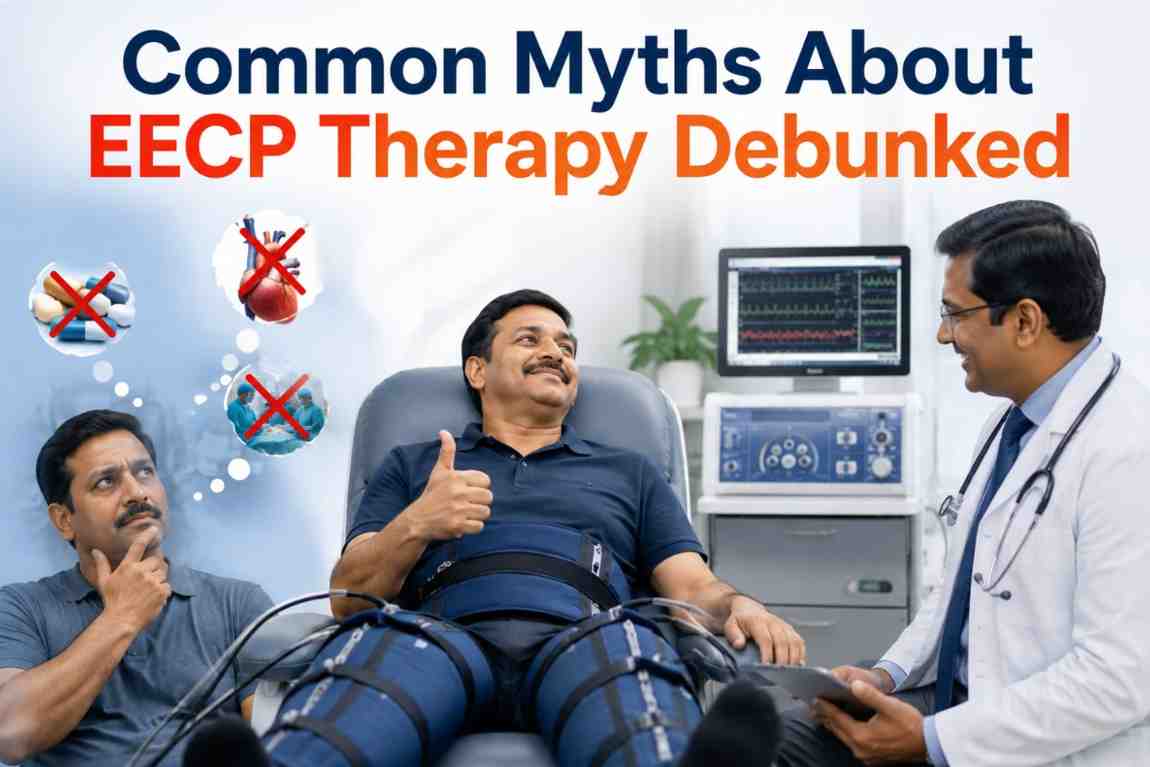
During treatment, cuffs are wrapped around the calves, lower thighs, and upper thighs. These cuffs inflate and deflate in careful sequence, timed to the patient’s own heartbeat using ECG monitoring. The inflation happens between heartbeats, which increases blood flow back toward the heart, and deflates just before the heart’s next contraction, reducing the workload on the heart at that moment.
Over a full course of sessions, this repeated pressure cycling is believed to encourage the development of small collateral blood vessels around narrowed or blocked coronary arteries — sometimes described as the body building its own natural detours around a blockage. A standard EECP course typically consists of daily one-hour sessions, five days a week, over seven weeks, for a total of thirty-five sessions, though a cardiologist may adjust this based on the individual patient.
EECP requires no incision, no anesthesia, and no hospital stay. Patients are awake throughout, and most resume normal activity immediately after each session.
Common Myths About EECP Therapy Debunked
Myth 1: “EECP Is Painful”
The Myth: A common fear is that having cuffs inflate tightly and repeatedly around your legs must be painful.
The Fact: Most patients describe the sensation as a firm squeezing or a rhythmic “milking” pressure on the legs — not pain. Some patients feel mild discomfort in the first session or two while they get used to the sensation, particularly if the cuffs need pressure adjustment. This typically settles quickly, and the pressure settings can be modified by the treating team if a patient finds a session uncomfortable. It is a very different experience from surgical pain, since there is no incision, no tissue cutting, and no wound to heal.
Myth 2: “EECP Is Unproven or Experimental”
The Myth: Because EECP isn’t as widely known as angioplasty or bypass surgery, some assume it’s a fringe or experimental treatment.
The Fact: EECP has been studied and used in clinical cardiology for several decades and is FDA-cleared for chronic stable angina and select heart failure indications. It is included as a treatment option in cardiology literature for patients with refractory angina who have not achieved adequate symptom control with standard therapy. It is not experimental — but like any therapy, it is not a universal fix, and its role is specific rather than all-encompassing.
Myth 3: “EECP Can Replace Bypass Surgery or Angioplasty for Everyone”
The Myth: Some patients hope EECP can simply substitute for surgery in every case, avoiding the operating table altogether.
The Fact: This is one of the more important myths to correct, because believing it can lead to delayed care. EECP is not a universal replacement for bypass surgery or angioplasty. Some patients — particularly those with severe, critical blockages, unstable angina, or certain acute presentations — genuinely need surgical or interventional treatment, and delaying that care in favor of EECP could be harmful. EECP is generally considered for patients with chronic stable angina, including those who are not ideal surgical candidates, or those who continue to have symptoms despite medication and previous procedures. Whether EECP is appropriate — instead of, before, or alongside another treatment — is a decision that belongs to a cardiologist after reviewing your specific case, not a blanket rule that applies to every patient.
Myth 4: “EECP Only Helps for a Short Time”
The Myth: A frequent claim is that any benefit from EECP fades away almost immediately after treatment ends.
The Fact: Clinical studies on EECP for chronic angina have reported symptom improvement that persists well beyond the treatment course for many patients, not just during the sessions themselves. That said, results vary from person to person, and EECP does not stop the underlying disease process. Ongoing risk-factor management — blood pressure control, cholesterol management, blood sugar control, and lifestyle changes — remains essential for maintaining benefit over time, exactly as it would after any cardiac procedure.
Myth 5: “EECP Is Only for Elderly Patients”
The Myth: Because EECP is sometimes discussed in the context of patients who aren’t candidates for surgery, some assume it’s specifically a therapy for the elderly.
The Fact: EECP is considered based on a patient’s cardiac condition and treatment history, not their age category alone. It is true that many patients referred for EECP are older adults with multiple health conditions that make surgery riskier, but younger patients with chronic stable angina who are not responding adequately to standard treatment may also be evaluated for EECP. Age is one factor a cardiologist considers, not a strict eligibility rule.
Myth 6: “There’s No Real Science Behind How EECP Works”
The Myth: Because the mechanism — external cuffs improving internal blood flow — sounds unusual, some assume there’s no real physiological basis for it.
The Fact: The mechanism is grounded in established cardiovascular physiology. The sequential cuff inflation increases diastolic blood flow (counterpulsation) and reduces the heart’s workload during systole. Over repeated sessions, this is understood to improve endothelial function and encourage collateral vessel development. It has a defined, ECG-synchronized mechanism — it is not a vague or unexplained therapy.
Myth 7: “EECP Requires Long Recovery Time, Like Surgery”
The Myth: Some patients assume that because EECP is a “heart treatment,” it must involve a recovery period similar to bypass surgery.
The Fact: EECP does not involve surgery, incisions, or anesthesia, so there is no surgical recovery period. Patients typically walk in, sit or lie through the hour-long session, and walk out afterward, resuming normal daily activities the same day. This is one of the more meaningful practical differences between EECP and invasive procedures, particularly for patients who cannot take extended time off work or family responsibilities.
Myth 8: “EECP Is Just a Wellness Trend, Not Real Medicine”
The Myth: Because EECP is sometimes marketed alongside general wellness or vascular health claims, some assume it isn’t a genuine medical treatment.
The Fact: EECP is delivered under medical supervision, requires ECG monitoring throughout each session, and is prescribed based on a documented cardiac diagnosis — not general wellness goals. It should always be administered by a qualified clinical team as part of a monitored treatment plan, not offered as a standalone lifestyle service. Any provider offering EECP without proper cardiac evaluation and monitoring should raise questions for a patient.
Myth 9: “If EECP Doesn’t Work Immediately, It’s Not Working at All”
The Myth: Patients sometimes expect noticeable relief after the first few sessions and assume the treatment has failed if they don’t feel a difference right away.
The Fact: EECP is a cumulative therapy. Its physiological effects — particularly collateral vessel development — build gradually over the full course of sessions rather than appearing after a handful of visits. Symptom improvement is generally assessed toward the latter part of, or after completing, the full recommended course, not after the first week. Patients are encouraged to discuss expectations and progress with their treating cardiologist throughout the course.
Myth 10: “EECP Has No Side Effects at All”
The Myth: In an effort to reassure patients, some sources swing too far the other way and claim EECP has zero side effects whatsoever.
The Fact: EECP is generally well tolerated, but like any medical treatment, it is not entirely without possible side effects. Some patients experience mild skin irritation, bruising, or discomfort at the cuff sites, particularly early in the course. Patients with certain conditions — including uncontrolled hypertension, significant peripheral vascular disease, certain arrhythmias, or bleeding disorders — may not be suitable candidates, which is exactly why a pre-treatment cardiac evaluation is required rather than optional.
How EECP Fits Alongside Other Heart Treatments
It’s worth stepping back from the myths for a moment to look at where EECP genuinely fits within the broader landscape of cardiac care, since no single treatment exists in isolation.
- Lifestyle modification — diet, physical activity, smoking cessation, and weight management remain the foundation of cardiac care regardless of which other treatments are used.
- Medications — antiplatelet drugs, statins, beta-blockers, nitrates, and antihypertensives are typically the first line of management for coronary artery disease and angina.
- EECP — considered for chronic stable angina, particularly when symptoms persist despite optimal medication, or when a patient is not a suitable candidate for surgical or interventional treatment.
- Angioplasty (PCI) with stenting — a catheter-based procedure to open a specific blocked artery, generally used for suitable blockages identified on angiography.
- Bypass surgery (CABG) — a surgical procedure to reroute blood flow around blocked arteries, typically reserved for more extensive or complex blockages.
- Cardiac rehabilitation — a structured, supervised program of exercise and education, often recommended after a cardiac event or procedure, and sometimes alongside EECP.
None of these options is universally “better” than the others. The right approach depends on the specific pattern of disease, overall health, prior treatment history, and a patient’s individual risk profile — which is precisely why cardiac treatment planning is done case by case.
When Might EECP Be Considered?
A cardiologist may discuss EECP as an option in situations such as:
- Chronic stable angina that continues despite appropriate medication
- Angina in patients who are not good candidates for bypass surgery or angioplasty due to overall health, extent of disease, or personal risk factors
- Patients who have already undergone bypass surgery or stenting but continue to experience angina symptoms
- Select cases of heart failure with reduced ejection fraction, as part of a broader treatment plan
- Patients seeking a non-surgical option and who meet the clinical criteria after evaluation
This list is general guidance, not a self-diagnosis checklist. Suitability for EECP can only be confirmed after a cardiologist reviews your ECG, cardiac history, current medications, and overall health status.
Why Early Medical Evaluation Matters
Chest discomfort, breathlessness on exertion, or a recent cardiac diagnosis can be genuinely frightening, and it’s natural to want quick answers. But the most protective step you can take isn’t reading more about a specific treatment online — it’s getting an accurate, individualized evaluation as early as possible.
An early evaluation allows your cardiologist to understand the true extent of your condition, rule out anything urgent, and lay out every appropriate option — medication adjustments, EECP, cardiac rehabilitation, or interventional and surgical treatment where needed — so that any decision you make is based on your actual heart, not on general information that may or may not apply to you.
Lifestyle Habits That Support Heart Health
Whatever treatment path you and your cardiologist decide on, day-to-day habits play a meaningful supporting role in cardiac health:
- Follow a heart-healthy diet — emphasizing vegetables, whole grains, lean protein, and limiting saturated fat, added sugar, and excess salt.
- Stay physically active as advised by your cardiologist — regular, moderate activity supports circulation and overall cardiac fitness.
- Quit smoking and avoid tobacco in every form, as it directly damages blood vessels and accelerates coronary artery disease.
- Manage blood pressure and blood sugar consistently, since uncontrolled hypertension and diabetes are major drivers of cardiac events.
- Prioritize sleep and manage stress, as both affect blood pressure, heart rate, and long-term cardiovascular risk.
- Take prescribed medications exactly as directed — never stop or adjust cardiac medication without your doctor’s guidance, even if you feel better.
- Attend follow-up appointments, since ongoing monitoring allows your treatment plan to be adjusted as your condition evolves.
Frequently Asked Questions
Is EECP painful?
No — most patients describe a firm pressure or squeezing sensation rather than pain. Any discomfort is usually mild and can often be adjusted by the treating team.
How long does a full EECP course take?
A standard course is typically thirty-five one-hour sessions, delivered five days a week over seven weeks, though your cardiologist may adjust this based on your condition.
Is EECP a substitute for bypass surgery or angioplasty?
Not universally. EECP is appropriate for specific patients, particularly those with chronic stable angina who aren’t ideal candidates for surgery or who continue to have symptoms after other treatments. Whether it replaces, precedes, or complements another treatment depends on individual evaluation.
Who should not undergo EECP?
Patients with certain conditions — including uncontrolled hypertension, significant peripheral vascular disease, certain arrhythmias, bleeding disorders, or unstable angina — may not be suitable candidates. A cardiac evaluation determines eligibility.
Does EECP have side effects?
EECP is generally well tolerated, but some patients experience mild skin irritation, bruising, or leg discomfort, particularly in early sessions.
When Should You Consult a Cardiologist?
You should speak with a cardiologist if you experience:
- Chest pain, pressure, or tightness — whether during exertion or at rest
- Breathlessness with everyday activity that is new or worsening
- Unexplained fatigue, particularly if it limits daily function
- A recent diagnosis of heart blockage, angina, or heart failure
- Continued symptoms despite ongoing medication or after a previous cardiac procedure
- Risk factors such as diabetes, high blood pressure, high cholesterol, or a family history of heart disease, even without current symptoms
If you experience sudden, severe chest pain, chest pain with sweating or nausea, pain spreading to the arm or jaw, or sudden severe breathlessness, this may be a medical emergency. Seek immediate emergency medical care rather than waiting for a scheduled appointment.
Why Choose KGK Hospital
KGK Hospital in Arumbakkam, Chennai, is a hospital focused specifically on EECP therapy and non-invasive cardiac care, led by Dr. K G Krishnaraja. Because the hospital’s practice is centered on this therapy rather than treating it as one service among many, the clinical team works closely with EECP protocols, patient monitoring, and candidacy assessment on a regular basis.
Every patient’s treatment plan at KGK Hospital begins with a review of medical history, current symptoms, and prior cardiac treatment, so that any recommendation — whether EECP, a referral for further intervention, or a combined approach — reflects that individual patient’s condition rather than a one-size-fits-all protocol. The hospital is located on Poonamallee High Road, Arumbakkam, accessible from Anna Nagar and surrounding areas of Chennai, which is a practical consideration for patients attending a multi-week course of sessions.
Conclusion
EECP therapy sits at an unusual intersection: it’s well-established in cardiology, yet still widely misunderstood by the public. The myths covered here — that it’s painful, unproven, a universal substitute for surgery, or completely free of any side effects — don’t hold up against current clinical evidence, but neither does the idea that EECP is right for absolutely everyone.
The most reliable way to know whether EECP, medication adjustment, cardiac rehabilitation, or a surgical option is right for you is a proper evaluation with a cardiologist familiar with your history — not a general article, however well-researched. If you or a family member are dealing with ongoing chest pain, breathlessness, or a cardiac diagnosis and want to understand your treatment options clearly, consider speaking with a cardiologist at KGK Hospital, Arumbakkam, Chennai, about whether EECP is worth discussing for your specific case.

About Author
At placerat eleifend nulla inceptos per dolor lacinia posuere. Rhoncus sociosqu dolor pharetra torquent interdum curabitur erat pellentesque.
Share Post :
Recent Posts
-
 Exercise After a Heart Diagnosis: What Is Safe and What Isn't
 -
 Heart-Healthy Diet Tips for Preventing Coronary Artery Disease
 -
 Cholesterol and Heart Health: What Your Numbers Really Mean
 -
 High Blood Pressure and Heart Disease: Understanding the Risk
 -
 Diabetes and Heart Disease: Why Early Prevention Matters
Categories
- What is EECP? (Educational)
- EECP vs Surgery (Comparison)
- Heart Health Tips Diabetes & Heart Care
- Patient Stories
- EECP in Tamil (தமிழில் EECP)
- Doctor Articles & Expert Advice
Subscribe Newsletter
Signup our newsletter to get update information, news, insight or promotions.
