
EECP Recovery Timeline: What to Expect After Each Session
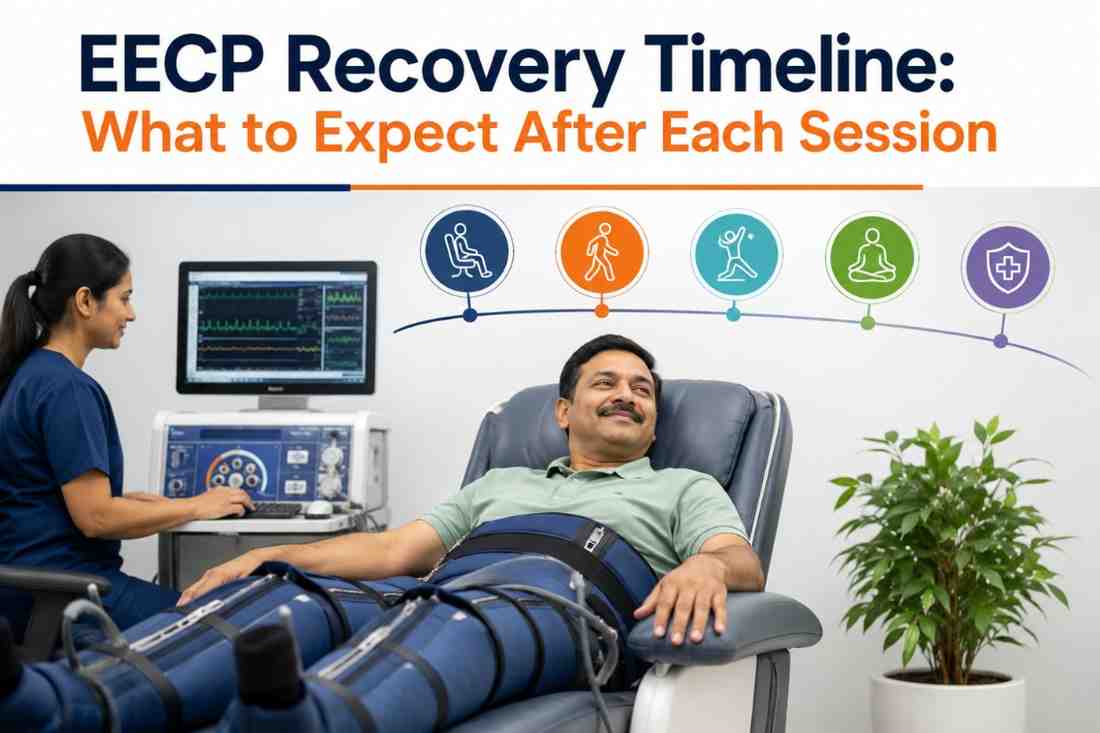
Understanding the EECP Recovery Timeline
Because EECP is a non-invasive, outpatient therapy delivered across many sessions rather than a single procedure, “recovery” looks different at each stage of your treatment journey. Breaking it down stage by stage helps set realistic expectations for what you’ll feel right after a session versus what benefits may take the full course to appear.
Immediately After Your Session (First Few Minutes)
As soon as your session ends and the cuffs are removed, most patients get up, get dressed, and are ready to leave. There’s no sedation to wear off and no incision to protect. Many patients are able to continue routine activities or work, but this depends on their symptoms, occupation and how they respond to treatment.
Later the Same Day
By the afternoon or evening of your session day, most patients report feeling entirely normal, though a smaller number notice mild leg fatigue or general tiredness, particularly during the earlier sessions of their course before their body adjusts to the daily routine. This tends to lessen as sessions continue.
Within Your First Week of Treatment
During the first week, many patients are still adjusting to the routine of daily visits. It’s common to feel slightly more aware of your legs after sessions during this period, though this is rarely limiting. Most people continue working, managing household responsibilities, and going about daily life without significant disruption during this stage.
Midway Through Your Treatment Course
By the middle of a standard treatment course, most patients have settled comfortably into the routine, with any initial leg fatigue typically having eased. Benefits may become noticeable during the later part of the treatment course, although timing varies and some patients notice changes earlier or later, though your cardiologist will emphasize that these benefits generally continue building through the reminder of the course.
By the End of Your Full EECP Course
Completing the full recommended course is when the cumulative therapeutic effect of EECP is best assessed. Many patients report noticeable improvement in angina symptoms and exercise capacity by this stage, evaluated by your cardiology team through follow-up assessment. Individual results vary, and your doctor will discuss your specific response to treatment.
What Is EECP Therapy?
Enhanced External Counterpulsation (EECP) is a non-invasive treatment for select heart conditions, most often chronic stable angina, using inflatable cuffs on the calves, thighs, and lower body that synchronize with your heartbeat to help improve blood flow to the heart over the course of treatment.
Causes and Risk Factors for Conditions Treated With EECP
Coronary artery disease and related angina, the conditions most often considered for EECP, are influenced by:
– High blood pressure
– Diabetes
– High cholesterol
– Smoking
– Sedentary lifestyle
– Family history of heart disease
– Obesity
Symptoms Worth Discussing With a Cardiologist
– Chest pain or discomfort, especially with exertion
– Shortness of breath
– Unusual fatigue during activity
– Pain radiating to the arm, jaw, or back
– Palpitations
Diagnosis: How Your Heart Condition Is Evaluated
Diagnosis typically involves clinical evaluation, ECG, stress testing, and sometimes imaging such as echocardiography or angiography, depending on your symptoms and risk profile. A cardiologist’s thorough assessment is essential before any treatment recommendation.
Treatment Options Beyond EECP
– Lifestyle modifications — Diet, exercise, and smoking cessation remain foundational
– Medications — Used to manage blood pressure, cholesterol, and angina symptoms
– EECP — Considered for select patients, often with persistent angina despite medication
– Angioplasty — A catheter-based procedure for certain blockage patterns
– Bypass surgery — For more extensive coronary artery disease
– Cardiac rehabilitation — A structured, supervised recovery and lifestyle program
EECP does not replace angioplasty or bypass surgery where those are clinically appropriate; it fills a different role for select patients.
When Might EECP Be Considered?
EECP may be considered for patients with chronic stable angina persisting despite optimized medication, or those not suitable candidates for more invasive procedures. Suitability is always determined through individualized cardiologist evaluation.
Benefits of Early Medical Evaluation
Seeking evaluation early when symptoms appear supports timely diagnosis and access to the full range of treatment options, allowing decisions to be made proactively.
Lifestyle Tips for Better Heart Health
– Follow a heart-healthy, balanced diet
– Engage in regular, doctor-approved activity
– Manage blood pressure, cholesterol, and blood sugar
– Avoid smoking and limit alcohol
– Prioritize sleep and stress management
– Take prescribed medications consistently
EECP Recovery Tips by Stage
– Before each session: Stay hydrated and wear comfortable clothing
– Immediately after: Take a few minutes to reorient before driving or resuming activity
– First week: Allow slightly more rest in the evenings if needed
– Mid-course: Maintain session consistency, this matters more for outcomes than any single day
– Throughout: Continue medications and lifestyle habits exactly as prescribed
Frequently Asked Questions
1. How long does EECP recovery take after each session?
There’s no formal recovery period; most patients resume normal activity within minutes. Mild fatigue, leg or muscle discomfort, or tiredness may occur after a session and can last from several hours to a few days, depending on the individual.
2. Can I work after an EECP session?
Yes, most patients return to work immediately, since EECP doesn’t involve sedation or invasive intervention.
3. What are common EECP after effects across the treatment course?
Mild leg fatigue and temporary cuff marks are most common, typically easing as your body adjusts to the daily routine over the first week or so.
4. When do EECP benefits typically appear in the timeline?
Benefits generally build cumulatively, with many patients noticing improvement by the midpoint to end of their full treatment course, evaluated by their cardiologist.
5. Is EECP recovery different from surgical recovery?
Yes, significantly. EECP involves no incisions or sedation, so there’s no traditional downtime, unlike surgical procedures.
When Should You Consult a Cardiologist?
Consult a cardiologist if you’re experiencing chest discomfort, unusual fatigue with exertion, or shortness of breath, or if you’d like to discuss whether EECP fits your treatment plan. Seek emergency care immediately for sudden, severe chest pain or symptoms suggestive of a heart attack.
Why Choose KGK EECP Hospital?
At KGK EECP Hospital in Arumbakkam, Chennai, our team specializes in EECP treatment alongside broader preventive cardiology care, helping patients understand exactly what to expect at each stage of their recovery timeline. We conduct thorough evaluation before recommending EECP, ensuring it’s genuinely appropriate for your condition, and our team remains available throughout your treatment course to address questions as they arise.
Conclusion
The EECP recovery timeline isn’t a single countdown, it’s a series of small, manageable stages: minutes after each session, the same day, your first week, and the full course. Understanding what to expect at each stage helps replace uncertainty with confidence. If you’re considering EECP, we encourage you to schedule a consultation with our cardiology team at KGK EECP Hospital, Arumbakkam, Chennai, for a thorough, individualized evaluation.

About Author
At placerat eleifend nulla inceptos per dolor lacinia posuere. Rhoncus sociosqu dolor pharetra torquent interdum curabitur erat pellentesque.
Share Post :
Recent Posts
-
 Exercise After a Heart Diagnosis: What Is Safe and What Isn't
 -
 Heart-Healthy Diet Tips for Preventing Coronary Artery Disease
 -
 Cholesterol and Heart Health: What Your Numbers Really Mean
 -
 High Blood Pressure and Heart Disease: Understanding the Risk
 -
 Diabetes and Heart Disease: Why Early Prevention Matters
Categories
- What is EECP? (Educational)
- EECP vs Surgery (Comparison)
- Heart Health Tips Diabetes & Heart Care
- Patient Stories
- EECP in Tamil (தமிழில் EECP)
- Doctor Articles & Expert Advice
Subscribe Newsletter
Signup our newsletter to get update information, news, insight or promotions.
