
EECP Treatment Procedure Explained: What Happens During a Session
Introduction
Walking into your first EECP session without knowing what to expect can feel a little unsettling — that’s completely understandable. Most patients have questions like: Will it hurt? How long does each session take? What exactly do the machines do? Getting a clear picture of the EECP treatment procedure beforehand tends to ease a lot of that uncertainty.
This article walks through exactly what happens during a session, from the moment you arrive to the moment you leave, so that you or a loved one considering this therapy can go in feeling informed and prepared.
What Is EECP Treatment?
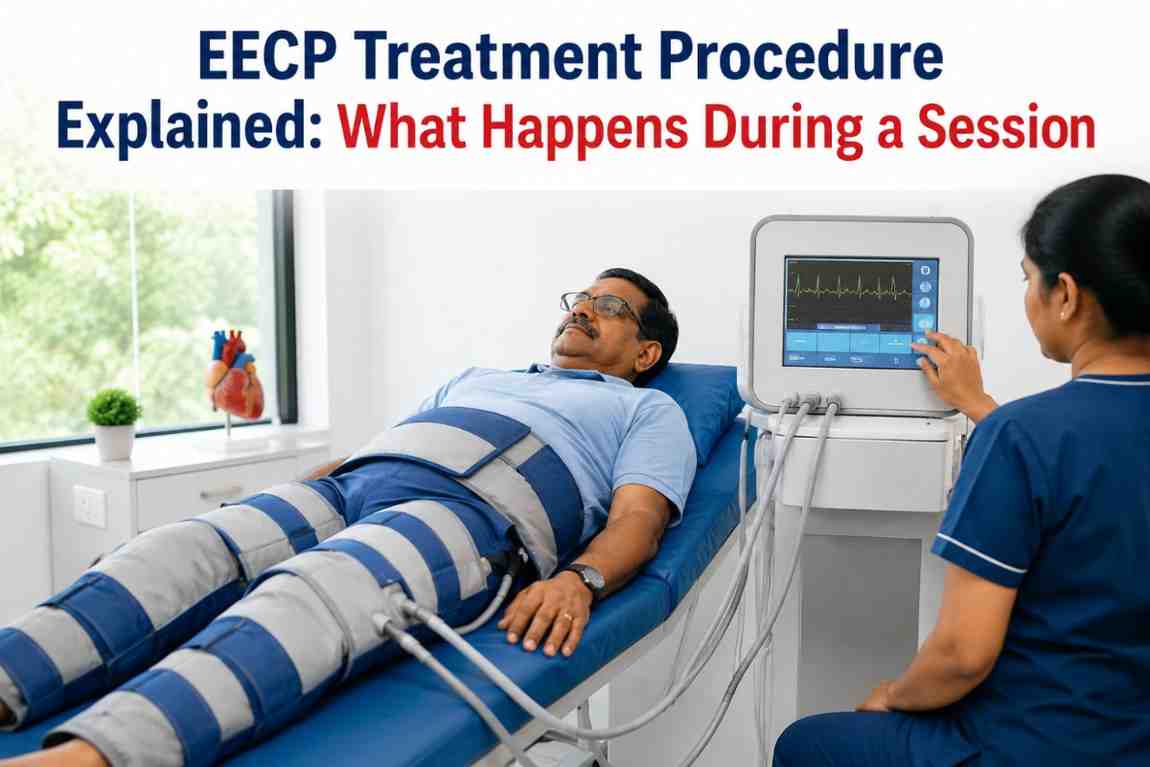
EECP stands for Enhanced External Counterpulsation. It’s a non-invasive, outpatient therapy used mainly to help manage chronic angina in patients with coronary artery disease. Three sets of pneumatic cuffs are wrapped around the calves, lower thighs, and upper thighs. These cuffs inflate and deflate in a precise sequence, timed to your heartbeat using ECG monitoring.
The goal is to increase blood flow to the heart during its resting phase and reduce the workload on the heart during its contraction phase. Over repeated sessions, this mechanical action is thought to help stimulate the growth of small collateral blood vessels around narrowed arteries, which may help reduce angina symptoms in suitable patients.
What Conditions Lead Patients to Consider EECP?
Patients typically explore EECP when they have:
- Chronic stable angina that continues despite optimized medication
- Coronary artery disease that isn’t well suited to angioplasty or bypass surgery
- Ongoing symptoms after a previous angioplasty or bypass procedure
- A preference to explore non-invasive options as part of their broader treatment plan, in consultation with their cardiologist
Symptoms That Bring Patients to EECP
Common symptoms that lead patients to discuss EECP with their cardiologist include:
- Chest tightness or pain during exertion
- Shortness of breath during everyday activities
- Fatigue that limits daily function
- Persistent angina despite taking prescribed heart medications
Who Typically Needs This Treatment?
EECP is generally considered for patients who:
- Have chronic angina not fully controlled by medication
- Aren’t ideal candidates for angioplasty or bypass surgery due to diffuse disease or other health conditions
- Have already undergone invasive procedures but continue to experience symptoms
- Are hemodynamically stable, with reasonably controlled blood pressure and heart rhythm
Candidacy always depends on an individual evaluation, since certain conditions like severe peripheral arterial disease or uncontrolled arrhythmias may make EECP unsuitable.
Diagnosis and Evaluation Before Starting
Before your first session, your cardiologist will typically review:
- Medical history — Past cardiac events, procedures, and other health conditions
- ECG — To assess your heart rhythm
- Echocardiogram — To evaluate heart valve function and pumping capacity
- Blood pressure control — Ensuring it’s reasonably well managed
- Vascular assessment — To rule out significant leg artery disease or blood clots
- Stress testing, where applicable, to understand your functional capacity
This evaluation determines not just whether EECP is appropriate, but also helps establish a baseline to measure your progress against later.
Step-by-Step: What Happens During an EECP Session
Here’s what a typical EECP session looks like from start to finish:
- Arrival and preparation You’ll be asked to wear comfortable clothing, often provided by the clinic, that allows the cuffs to be placed directly against your legs. You’ll lie down on a padded treatment table.
- ECG electrode placement A few ECG electrodes are attached to your chest to monitor your heart’s electrical activity throughout the session. This allows the machine to synchronize cuff inflation and deflation precisely with your heartbeat.
- Cuff placement Three sets of cuffs are wrapped around your calves, lower thighs, and upper thighs (and sometimes buttocks).
- Blood pressure and pulse monitoring A finger sensor or similar device tracks your blood pressure and pulse waveform throughout the session, which helps the technician adjust cuff pressure appropriately.
- Synchronized inflation and deflation During diastole (when your heart relaxes between beats), the cuffs inflate in a sequential wave — starting at the calves and moving upward — pushing blood back toward the heart. Just before systole (when your heart contracts to pump blood out), the cuffs deflate rapidly, reducing the resistance the heart works against.
- Continuous monitoring Throughout the hour-long session, a trained technician monitors your ECG, blood pressure, and comfort level, adjusting cuff pressure as needed.
- Session completion Once the hour is complete, the cuffs and electrodes are removed. Most patients can get up, get dressed, and resume their day immediately.
How Many Sessions Are Typically Needed?
A standard full course of EECP typically involves 35 one-hour sessions, usually scheduled five days a week over about seven weeks. In some cases, cardiologists may recommend a different number of sessions based on how a patient responds or their specific clinical situation. Your treatment plan will be tailored to your individual case rather than a fixed formula.
What You Might Feel During Treatment
Most patients describe the sensation as a firm, rhythmic squeezing on the legs — similar to a strong hug or a blood pressure cuff being inflated repeatedly. It is generally not described as painful, though some patients notice mild leg discomfort, particularly in the first few sessions as they get used to the sensation.
Other things patients sometimes report include:
- Mild skin irritation or redness where the cuffs sit
- Temporary leg fatigue after a session
- A feeling of relaxation, since many patients rest or even doze off during sessions
If you experience significant discomfort at any point, let your technician know — cuff pressure can often be adjusted.
Life After Each Session
Because EECP is non-invasive and doesn’t require anesthesia, there’s no recovery period in the way there would be after a surgical procedure. Most patients:
- Get up and walk immediately after the session
- Resume normal daily activities right away
- Continue taking their prescribed medications as directed by their cardiologist
- Return the next scheduled day for their next session
Some patients report feeling improvement in their angina symptoms partway through the course, while others notice changes closer to the end of the full 35-session program. Response varies from person to person.
How EECP Compares to Other Treatment Options
Factor | EECP | Angioplasty (PCI) | Bypass Surgery (CABG) |
Invasiveness | Non-invasive | Invasive (catheter-based) | Invasive (surgical) |
Anesthesia required | No | Local/sedation | General anesthesia |
Hospital stay | None | Brief | Several days |
Session/recovery time | 35 hours over ~7 weeks | Hours to a day | Weeks |
Typical use | Chronic stable angina | Significant blockages, urgent cases | Multi-vessel disease |
These treatments generally serve different clinical purposes rather than directly competing with one another. Your cardiologist can help determine which approach, or combination of approaches, fits your specific diagnosis.
Benefits of Early Medical Evaluation
Getting evaluated as soon as symptoms appear — rather than waiting — gives you and your cardiologist more clarity on your options. Early evaluation can help:
- Determine whether EECP or another treatment is more appropriate for your case
- Establish a clear baseline before starting any treatment
- Reduce the chances of delays once you’re ready to begin
- Support calmer, better-informed decision-making
Lifestyle Tips for Better Heart Health
Alongside any treatment you undergo, these habits support better long-term outcomes:
- Follow a heart-healthy diet low in saturated fat, salt, and added sugar
- Stay physically active within limits approved by your doctor
- Maintain a healthy weight
- Quit smoking completely
- Manage stress through sleep, relaxation, or counseling
- Take all prescribed medications consistently
- Attend regular follow-up appointments
Frequently Asked Questions
1. Is the EECP procedure painful?
No. Most patients describe a firm squeezing sensation rather than pain, though mild leg discomfort can occur, especially early on.
2. How long does each session last?
Each session typically lasts about one hour.
3. How many total sessions will I need?
A standard full course involves 35 sessions, though your cardiologist may adjust this based on your individual response and condition.
4. Do I need to stay overnight at the hospital?
No. EECP is an outpatient procedure — you go home the same day after each session.
5. Can I drive myself home after a session?
Most patients are able to resume normal activities, including driving, immediately after a session, but this can vary by individual — check with your care team.
6. Will I need anesthesia?
No. EECP does not require anesthesia or sedation of any kind.
7. Can I continue my heart medications during EECP?
Yes, generally patients continue their prescribed medications unless their cardiologist advises otherwise.
8. What does the equipment look like?
The treatment table has three sets of inflatable cuffs that wrap around the legs, connected to a machine that synchronizes inflation and deflation with your heartbeat via ECG monitoring.
9. Will I feel anything after the session ends?
Some patients notice mild leg fatigue or skin irritation that resolves within a day or so. Significant or persistent discomfort should be reported to your care team.
10. How soon will I notice a difference in my symptoms?
This varies. Some patients report improvement partway through the course, while others notice changes closer to completion.
11. Can I skip sessions if I feel fine?
It’s best to complete the full recommended course as advised by your cardiologist, since consistency is generally important for the treatment’s intended effect.
12. What happens if I feel unwell during a session?
Let your technician know immediately. Sessions are closely monitored, and cuff pressure or the session itself can be adjusted as needed.
When Should You Consult a Cardiologist?
Reach out to a cardiologist if you experience:
- Ongoing angina despite taking prescribed medication
- Shortness of breath during everyday activities
- Uncertainty about whether EECP or another treatment fits your situation
- Questions about starting or continuing EECP therapy
Seek emergency care immediately if you experience sudden, severe chest pain, pain radiating to the arm or jaw accompanied by sweating or nausea, or sudden shortness of breath — these can indicate a heart attack and require urgent attention, not a scheduled appointment.
Why Choose KGK EECP Hospital?
KGK EECP Hospital in Anna Nagar, Chennai, offers a dedicated, structured EECP treatment process overseen by an experienced cardiology team. Each session is closely monitored using ECG and blood pressure tracking, and treatment plans are tailored to the individual patient’s evaluation rather than a one-size-fits-all protocol.
Patients curious about what the EECP procedure involves, or considering starting treatment, can schedule a consultation to have their situation reviewed and their questions answered directly by the care team.
Conclusion
Understanding exactly what happens during an EECP session — from cuff placement to ECG monitoring to how you’ll feel afterward — can make the idea of starting treatment feel much less uncertain. It’s a structured, closely monitored process, but one where your comfort and safety are checked throughout each session.
If you’re considering EECP or want to understand whether it fits your specific heart condition, the best next step is a conversation with a qualified cardiologist who can walk you through your personal treatment plan.

About Author
At placerat eleifend nulla inceptos per dolor lacinia posuere. Rhoncus sociosqu dolor pharetra torquent interdum curabitur erat pellentesque.
Share Post :
Recent Posts
-
 Exercise After a Heart Diagnosis: What Is Safe and What Isn't
 -
 Heart-Healthy Diet Tips for Preventing Coronary Artery Disease
 -
 Cholesterol and Heart Health: What Your Numbers Really Mean
 -
 High Blood Pressure and Heart Disease: Understanding the Risk
 -
 Diabetes and Heart Disease: Why Early Prevention Matters
Categories
- What is EECP? (Educational)
- EECP vs Surgery (Comparison)
- Heart Health Tips Diabetes & Heart Care
- Patient Stories
- EECP in Tamil (தமிழில் EECP)
- Doctor Articles & Expert Advice
Subscribe Newsletter
Signup our newsletter to get update information, news, insight or promotions.
Subscribe Newsletter
Signup our newsletter to get update information, news, insight or promotions.
