
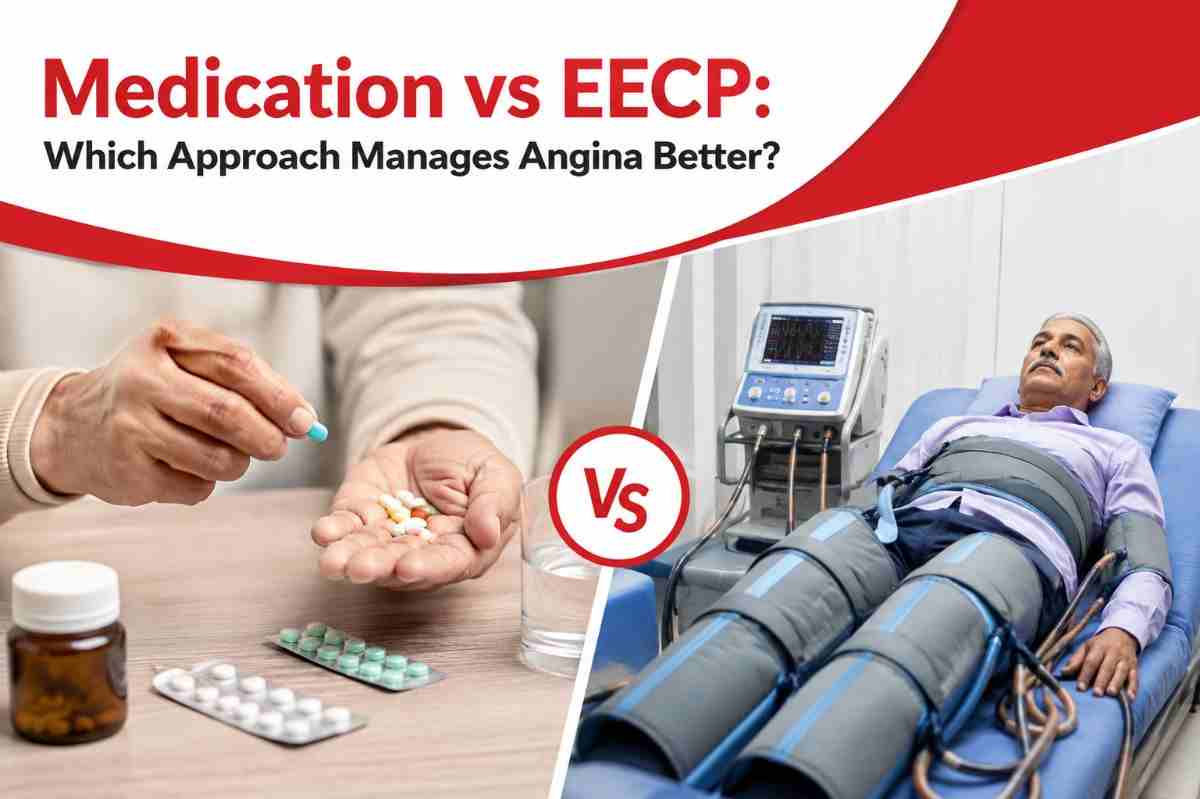
Medication vs EECP: Which Approach Manages Angina Better?
Understanding the Question Behind This Comparison
If you’ve been living with angina for a while, you’ve probably asked some version of this question yourself: is it better to just keep adjusting my medication, or should I look into something like EECP? It’s a fair question, especially if your chest discomfort keeps interrupting daily life despite following your prescription exactly as directed.
The honest answer is that “medication vs EECP” isn’t really a competition with one winner. It’s closer to two different tools that address angina from different angles, and for many patients, the real conversation isn’t which one to choose, but whether EECP has a role to play alongside the medication you’re already on. This article walks through how each approach works, where they overlap, where they differ, and how a cardiologist actually decides what combination makes sense for a specific patient.
What Is Angina?
Angina is chest pain or discomfort that occurs when the heart muscle isn’t getting enough oxygen-rich blood, usually because one or more coronary arteries are narrowed by plaque buildup (atherosclerosis). It isn’t a disease in itself — it’s a symptom of underlying coronary artery disease, and it acts as a signal that the heart is being asked to work harder than the narrowed arteries can comfortably supply.
Angina is generally categorized as:
- Stable angina — predictable chest discomfort that occurs with exertion or stress and typically resolves with rest or medication.
- Unstable angina — new, worsening, or occurring at rest, and considered a medical emergency requiring immediate attention.
- Variant (Prinzmetal) angina — caused by coronary artery spasm rather than blockage alone, often occurring at rest.
This article focuses primarily on the management of chronic stable angina, since that is the context in which medication and EECP are most commonly compared.
Causes of Angina
Angina most commonly results from:
- Coronary artery disease (CAD) — narrowing of the coronary arteries due to plaque buildup, the most common underlying cause.
- Coronary artery spasm — temporary tightening of a coronary artery, reducing blood flow.
- Increased oxygen demand — situations such as physical exertion, emotional stress, or extreme temperatures that ask more of the heart than narrowed arteries can supply.
- Other heart conditions — including certain valve disorders or abnormal heart rhythms that affect blood flow.
Symptoms of Angina
Angina can feel different from person to person, but common symptoms include:
- Chest pain, pressure, tightness, or a squeezing sensation
- Discomfort spreading to the arm, shoulder, neck, jaw, or back
- Shortness of breath, particularly during exertion
- Fatigue with activity that wasn’t previously tiring
- Nausea, sweating, or lightheadedness in some cases
Symptoms triggered by exertion and relieved by rest are typical of stable angina. Chest pain that is new, worsening, occurring at rest, or accompanied by sweating and breathlessness needs urgent medical evaluation.
Risk Factors for Angina
You may be at higher risk of angina and underlying coronary artery disease if you have:
- High blood pressure (hypertension)
- High LDL cholesterol or abnormal lipid levels
- Diabetes or insulin resistance
- A history of smoking or tobacco use
- A family history of heart disease
- Obesity or a sedentary lifestyle
- Advancing age, with risk increasing over time
- Chronic stress or poor sleep patterns
Having one or more of these factors doesn’t guarantee you’ll develop angina, but it does mean cardiac screening and preventive care are worth discussing with a doctor.
How Angina Is Diagnosed
Diagnosing angina and its underlying cause typically involves a combination of the following, determined by a cardiologist based on your symptoms and history:
- Clinical history and physical examination — understanding when symptoms occur and what triggers them.
- Electrocardiogram (ECG) — evaluating the heart’s electrical activity.
- Stress testing — assessing how the heart performs under exertion.
- Echocardiogram — imaging the heart’s structure and function.
- Coronary angiography — direct imaging of the coronary arteries to identify blockages, when indicated.
- Blood tests — checking cholesterol, blood sugar, and cardiac markers where relevant.
A confirmed diagnosis, and an understanding of exactly how severe and where the blockages are, is what allows a cardiologist to recommend the right combination of treatments — this cannot be determined from symptoms alone.
Medication for Angina: How It Works
Medication is generally the starting point for managing angina and works through several different mechanisms, often used in combination:
- Nitrates (such as nitroglycerin) — relax and widen blood vessels, improving blood flow and relieving acute chest pain.
- Beta-blockers — reduce heart rate and the force of contraction, lowering the heart’s oxygen demand.
- Calcium channel blockers — relax coronary arteries and reduce workload on the heart.
- Antiplatelet medication (such as aspirin) — reduce the risk of clot formation in narrowed arteries.
- Statins — manage cholesterol levels to slow the progression of underlying plaque buildup.
- ACE inhibitors or ARBs — used in some patients to manage blood pressure and protect heart function.
For many patients with stable angina, appropriately prescribed medication significantly reduces symptom frequency and severity. However, some patients continue to experience angina despite being on optimal medical therapy — a situation often described clinically as “refractory angina” — and this is where other options, including EECP, are typically discussed.
EECP for Angina: How It Works
EECP, or Enhanced External Counterpulsation, is a non-invasive, FDA-approved therapy that takes a mechanical rather than pharmacological approach to improving blood flow to the heart.
During each session, cuffs wrapped around the calves, lower thighs, and upper thighs inflate and deflate in sequence, timed precisely to the patient’s heartbeat via ECG monitoring. This increases blood flow toward the heart between heartbeats and reduces the heart’s workload just before its next contraction. Over a full course of sessions — typically thirty-five one-hour sessions delivered five days a week over seven weeks — this repeated cycling is understood to encourage the development of small collateral blood vessels around narrowed arteries, essentially helping the body form natural detours around a blockage.
EECP does not replace the need for medication in most cases. Rather, it’s generally used alongside prescribed medication, particularly for patients whose angina persists despite standard drug therapy or who are not ideal candidates for angioplasty or bypass surgery.
Medication vs EECP: A Side-by-Side Comparison
| Factor | Medication | EECP |
| How it works | Chemically reduces heart’s oxygen demand, widens vessels, prevents clots | Mechanically improves blood flow and encourages collateral vessel growth |
| Invasiveness | Non-invasive (oral or sometimes injectable) | Non-invasive (external cuffs, no incision) |
| Typical starting point | First-line treatment for most angina patients | Usually considered after or alongside medication |
| Time commitment | Ongoing daily use | A defined course, typically over several weeks |
| Onset of effect | Often relatively quick, especially for acute symptom relief | Builds gradually over the full course of sessions |
| Best suited for | Most patients with stable angina as initial management | Patients with persistent angina despite medication, or limited surgical options |
| Ongoing need | Usually continues long-term | Course-based, though may be repeated if advised |
| Replaces the other? | No — often used together with EECP when indicated | No — typically used alongside medication, not instead of it |
This table is a general comparison, not a personalized recommendation. Many patients are on medication and are evaluated for EECP at the same time — the two are frequently partners in a treatment plan rather than opposing choices.
Can EECP Reduce Reliance on Angina Medication?
This is one of the most common questions patients ask, and it deserves a careful answer. For some patients, effective EECP treatment is associated with improved symptom control, which may allow a cardiologist to reassess and, where appropriate, adjust medication dosing over time.
However, this is not automatic, guaranteed, or something a patient should attempt on their own. Any change to prescribed heart medication — including dosage reduction — should only be made by your treating cardiologist based on your ongoing clinical response, never self-directed based on how you feel after a course of EECP. Stopping or reducing cardiac medication without medical guidance can be genuinely dangerous, even if your symptoms have improved.
When Might EECP Be Considered?
A cardiologist may raise EECP as an option in situations such as:
- Chronic stable angina that continues despite being on optimal medication
- Patients who are not ideal candidates for angioplasty or bypass surgery due to the extent of disease or overall health
- Patients who continue to experience angina after previous stenting or bypass surgery
- Select cases of heart failure with reduced ejection fraction, as part of a broader treatment plan
- Patients specifically seeking a non-surgical option, once evaluated as clinically appropriate
Suitability for EECP is determined only after a cardiologist reviews your cardiac history, current medications, and diagnostic results — not by matching your situation to a general list.
Benefits of Early Medical Evaluation
Angina that disrupts your daily routine, or medication that no longer feels like it’s controlling your symptoms well, are both good reasons to seek an updated evaluation — not reasons to wait until things get worse. An early conversation with a cardiologist allows your treatment plan to be reassessed properly: is your current medication regimen still optimal, has your coronary artery disease progressed, and would EECP, cardiac rehabilitation, or a procedural option add real value to your care.
Getting this evaluation early, rather than adjusting your own medication use or delaying care, gives you and your cardiologist the clearest possible picture of what’s actually happening and what your best next step looks like.
Lifestyle Tips for Better Heart Health
Alongside medication and any procedural treatment, everyday habits play a meaningful role in managing angina and slowing the progression of coronary artery disease:
- Follow a heart-healthy diet — rich in vegetables, whole grains, and lean protein, while limiting saturated fat, added sugar, and excess salt.
- Stay physically active within limits set by your cardiologist — regular activity supports circulation and cardiovascular fitness.
- Quit smoking completely, as tobacco use directly accelerates coronary artery disease and worsens angina.
- Manage blood pressure, cholesterol, and blood sugar consistently through both medication adherence and lifestyle habits.
- Reduce stress where possible, since emotional stress is a recognized trigger for angina episodes.
- Take medications exactly as prescribed, without skipping doses or adjusting them based on how you feel on a given day.
- Keep all follow-up appointments, so your treatment plan can be adjusted as your condition changes over time.
Frequently Asked Questions
Is EECP better than medication for angina?
Neither is universally “better.” Medication is typically the first-line approach, and EECP is generally considered alongside or after medication, particularly when symptoms persist. The right combination depends on individual evaluation.
Can I choose EECP instead of taking angina medication?
This decision should always be made with your cardiologist. EECP is usually used alongside prescribed medication, not as a substitute for it, especially in the early stages of treatment.
Does EECP help if medication isn't fully controlling my angina?
For patients with angina that persists despite optimal medication, EECP is one option a cardiologist may discuss, alongside reviewing whether medication adjustments or further intervention are appropriate.
How long does a full EECP course take?
A standard course is typically thirty-five one-hour sessions, delivered five days a week over seven weeks, though this may be adjusted based on your condition.
Will EECP allow me to stop taking my heart medication?
Not automatically. Any reduction or change in medication must be guided and confirmed by your cardiologist based on your clinical response — never self-directed.
When Should You Consult a Cardiologist?
Reach out to a cardiologist if you experience:
- Angina symptoms that are becoming more frequent, severe, or occurring with less exertion than before
- Chest discomfort that no longer responds as expected to your current medication
- New symptoms such as breathlessness, fatigue, or swelling alongside your angina
- Continued angina despite following your prescribed treatment plan consistently
- Uncertainty about whether your current management plan is still the right one for you
If you experience sudden, severe chest pain, chest pain accompanied by sweating or nausea, pain spreading to the arm or jaw, or sudden severe breathlessness, this may be a medical emergency. Seek immediate emergency medical care rather than waiting for a scheduled appointment.
Why Choose KGK Hospital
KGK Hospital in Arumbakkam, Chennai, focuses specifically on EECP therapy and non-invasive cardiac care, under the guidance of Dr. K G Krishnaraja. Because this is a dedicated area of focus rather than one service among many, the clinical team is closely familiar with how EECP fits alongside medication management for angina patients, rather than treating it as a standalone or isolated therapy.
Each patient’s plan begins with a review of medical history, current medications, and prior cardiac treatment, so that any recommendation reflects that individual’s actual clinical picture rather than a generic protocol. The hospital is located on Poonamallee High Road, Arumbakkam, accessible from Anna Nagar and surrounding parts of Chennai — a practical consideration for patients attending a multi-week course of EECP sessions while continuing their regular medication routine.
Conclusion
Medication and EECP aren’t really rivals competing for the same job — they’re two different approaches that, for many angina patients, work best in combination rather than isolation. Medication addresses angina chemically and is usually where treatment begins; EECP addresses it mechanically and is usually considered when symptoms need additional support beyond medication alone.
Rather than trying to decide which approach is “better” in the abstract, the more useful question is what combination is right for your specific coronary artery disease, symptom pattern, and overall health — and that’s a question only a proper cardiac evaluation can answer. If your angina isn’t as well controlled as you’d like, or you’re simply curious whether EECP has a role in your care, consider speaking with a cardiologist at KGK Hospital, Arumbakkam, Chennai, about your options.

About Author
At placerat eleifend nulla inceptos per dolor lacinia posuere. Rhoncus sociosqu dolor pharetra torquent interdum curabitur erat pellentesque.
Share Post :
Recent Posts
-
 Exercise After a Heart Diagnosis: What Is Safe and What Isn't
 -
 Heart-Healthy Diet Tips for Preventing Coronary Artery Disease
 -
 Cholesterol and Heart Health: What Your Numbers Really Mean
 -
 High Blood Pressure and Heart Disease: Understanding the Risk
 -
 Diabetes and Heart Disease: Why Early Prevention Matters
Categories
- What is EECP? (Educational)
- EECP vs Surgery (Comparison)
- Heart Health Tips Diabetes & Heart Care
- Patient Stories
- EECP in Tamil (தமிழில் EECP)
- Doctor Articles & Expert Advice
Subscribe Newsletter
Signup our newsletter to get update information, news, insight or promotions.
