
When Is Surgery Necessary and When Can Conservative Management Work?
A Question Almost Every Heart Patient Asks
“Do I really need surgery for this?” It’s one of the first questions patients ask after being told they have a blocked artery, and it’s a completely reasonable one. Surgery carries real weight — recovery time, risk, cost, and simply the idea of undergoing a major procedure. So it makes sense to want to know: is this blockage serious enough that surgery is genuinely necessary, or can it be managed conservatively?
The honest answer is that it depends entirely on what your specific arteries look like, not on how the blockage feels day to day. Two patients with similar symptoms can have very different underlying disease patterns — one might be perfectly suited to medication and lifestyle changes, while the other genuinely needs a procedure to avoid a serious event. This article walks through how that decision is actually made, and where non-surgical options, including EECP, fit into the picture.
What Is Coronary Artery Disease?
Coronary artery disease (CAD) develops when the arteries supplying blood to the heart muscle become narrowed due to plaque buildup (atherosclerosis). As arteries narrow, the heart receives less oxygen-rich blood, which can cause angina — chest discomfort, typically with exertion — and, if a blockage becomes severe or a plaque ruptures suddenly, a heart attack.
CAD exists on a spectrum. Some patients have mild, diffuse narrowing that doesn’t significantly limit blood flow. Others have one or more severe, localized blockages that meaningfully restrict circulation. This spectrum — not the presence of a blockage alone — is what ultimately determines whether conservative management, a procedure, or surgery is the appropriate path.
Causes of Coronary Artery Disease
CAD typically develops due to:
- Atherosclerosis — gradual buildup of cholesterol, fat, and other substances along artery walls
- Chronic high blood pressure — which damages artery walls over time and accelerates plaque formation
- Elevated blood sugar (diabetes) — a significant contributor to vascular damage
- Smoking and tobacco use — a direct and well-established driver of artery damage
- Chronic inflammation — increasingly understood to contribute to plaque development and instability
Symptoms That Bring Patients to a Cardiologist
Patients often first seek evaluation because of:
- Chest pain, tightness, or pressure, especially during physical activity
- Shortness of breath with exertion
- Fatigue that seems disproportionate to effort
- Discomfort radiating to the arm, jaw, neck, or back
- In acute situations: sudden chest pain, sweating, nausea, or breathlessness at rest
Symptoms that occur predictably with exertion and ease with rest often point toward stable disease that may be managed conservatively. Symptoms that are new, worsening, or occurring at rest require urgent evaluation, since they may indicate a more unstable situation.
Risk Factors
Your risk of developing coronary artery disease is higher if you have:
- High blood pressure or high cholesterol
- Diabetes or insulin resistance
- A history of smoking
- A family history of heart disease
- Obesity or a sedentary lifestyle
- Advancing age
- Chronic stress or poor sleep patterns
How Coronary Artery Disease Is Diagnosed
Determining whether conservative management or a procedure is appropriate relies on a proper diagnostic workup, which may include:
- Clinical history and examination — understanding your symptoms, triggers, and risk factors
- ECG — assessing the heart’s electrical activity
- Stress testing — evaluating how your heart performs under exertion
- Echocardiogram — imaging heart structure and function
- Coronary angiography — the key test that shows the precise location, number, and severity of blockages, and largely determines whether surgery or a procedure is needed
- Blood tests — assessing cholesterol, blood sugar, and cardiac markers
It’s worth emphasizing: the decision about surgery versus conservative management is made based on objective findings from these tests, particularly angiography — not based on how severe your symptoms feel subjectively, since symptom severity and blockage severity don’t always match up.
What Does Conservative Management Actually Involve?
Conservative management refers to treating coronary artery disease without surgery or a catheter-based procedure. It typically includes:
- Medication — such as antiplatelet drugs, statins, beta-blockers, nitrates, and blood pressure medication, used to reduce symptoms and slow disease progression
- Lifestyle modification — diet, physical activity, smoking cessation, and weight management
- Risk factor control — managing blood pressure, cholesterol, and blood sugar closely
- Cardiac rehabilitation — structured, supervised exercise and education programs
- EECP — a non-invasive therapy considered for select patients with chronic stable angina, discussed further below
Conservative management is not a “lesser” option chosen only when surgery isn’t available — for many patients with stable, well-controlled coronary artery disease, it’s the clinically appropriate first-line approach, sometimes for years or indefinitely.
When Does Surgery or a Procedure Become Necessary?
Surgery or a catheter-based procedure typically becomes necessary — rather than optional — in situations such as:
- Severe blockages in critical locations, particularly involving the left main coronary artery or multiple vessels
- Unstable angina or acute coronary syndrome, where blood flow is at immediate risk
- Heart attack (myocardial infarction), where urgent restoration of blood flow is time-critical
- Blockages causing significant symptoms despite optimal medication
- Extensive multi-vessel disease, particularly in patients with diabetes, where bypass surgery may offer better long-term outcomes than stenting alone
- Structural complications, such as certain valve problems occurring alongside coronary disease
In these situations, delaying a necessary procedure in favor of conservative management alone can carry real risk — this is precisely why the decision must be based on proper diagnostic imaging and a cardiologist’s assessment, not on a preference for avoiding surgery.
Conservative Management vs Surgery: A Side-by-Side Comparison
Factor | Conservative Management | Surgery / Procedure (Bypass or Stenting) |
Approach | Medication, lifestyle, EECP, rehabilitation | Catheter-based (stent) or open surgical (bypass) |
When typically used | Stable, mild-to-moderate, well-controlled disease | Severe, extensive, or unstable blockages; acute events |
Invasiveness | Non-invasive | Invasive (procedure or surgery) |
Onset of benefit | Gradual, ongoing | Often immediate restoration of blood flow |
Recovery | No procedural recovery | Recovery period, varying by procedure type |
Long-term commitment | Ongoing medication and lifestyle management | May still require ongoing medication afterward |
Risk of delay if inappropriate | Can be significant if disease is actually severe | Not applicable — addresses the blockage directly |
This table illustrates general patterns, not a decision tool. The right path for you depends entirely on what your angiogram and other test results show.
Where Does EECP Fit Into This Picture?
EECP, or Enhanced External Counterpulsation, sits within the conservative management category, but deserves its own explanation because it’s often misunderstood as either “just like medication” or “a replacement for surgery” — it’s neither.
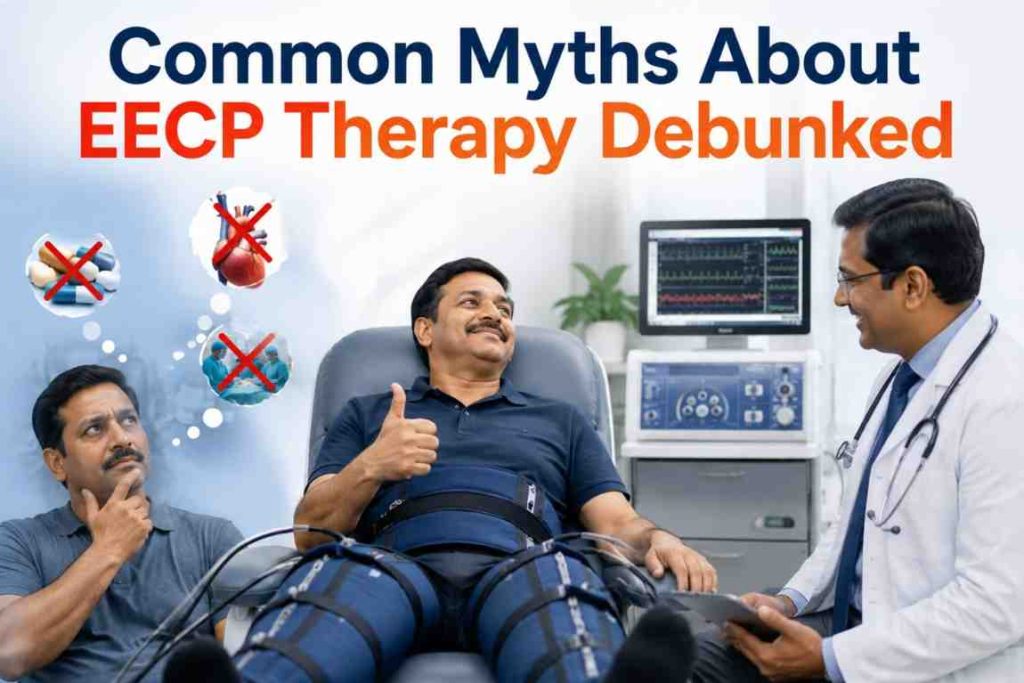
EECP is a non-invasive, FDA-approved therapy in which cuffs wrapped around the calves, lower thighs, and upper thighs inflate and deflate in sequence, synchronized to the heartbeat via ECG monitoring. This increases blood flow to the heart between heartbeats and reduces the heart’s workload just before each contraction. A standard course typically consists of thirty-five one-hour sessions, delivered five days a week over seven weeks.
EECP is generally considered for patients with chronic stable angina who continue to have symptoms despite medication, or who are not ideal candidates for surgery or stenting due to the pattern of their disease or their overall health. It is not a treatment for acute blockages or unstable angina, and it does not replace the need for surgery when surgery is genuinely indicated.
When Might EECP Be Considered?
A cardiologist may raise EECP as part of a conservative management plan in situations such as:
- Chronic stable angina persisting despite optimal medication
- Diffuse coronary artery disease not well suited to stenting or bypass
- Patients considered high-risk for surgery or angioplasty due to overall health
- Continued angina after previous stenting or bypass surgery
- Select cases of heart failure with reduced ejection fraction, as part of a broader plan
Whether EECP is appropriate for you specifically can only be confirmed after a cardiologist reviews your angiography results, cardiac history, and overall health — not by matching your situation to a general list.
Benefits of Early Medical Evaluation
One of the most reassuring things about early evaluation is that it often reveals more options are available than a patient initially assumes. A patient who fears they’ll “definitely need surgery” may, after proper testing, find that their disease is well suited to conservative management. Conversely, a patient hoping to avoid a procedure at all costs may need to know clearly that their blockage pattern makes surgery the safer path.
Either way, early evaluation — rather than delaying out of fear of what the answer might be — is what allows this to be determined accurately and gives you time to make an informed decision, rather than facing an urgent decision under pressure.
Lifestyle Tips for Better Heart Health
Regardless of which treatment path you and your cardiologist choose, these habits support the health of your coronary arteries over time:
- Eat a heart-healthy diet — emphasizing vegetables, whole grains, and lean protein while limiting saturated fat, added sugar, and excess salt.
- Stay physically active as advised by your cardiologist, since regular movement supports circulation and vascular health.
- Quit smoking entirely, as tobacco use directly damages artery walls and accelerates plaque buildup.
- Control blood pressure, cholesterol, and blood sugar through consistent medication use and lifestyle habits.
- Manage stress and prioritize sleep, both of which influence blood pressure and cardiovascular risk over time.
- Take all prescribed medications as directed, including after a stent is placed, since medication (such as antiplatelet therapy) plays a critical role in keeping a stent functioning well.
- Attend all follow-up appointments, so your cardiologist can monitor your arteries and adjust your treatment plan as needed.
Frequently Asked Questions
Is EECP a real alternative to getting a stent?
In some cases, yes — particularly for patients with diffuse disease not suited to stenting, or those at higher risk for the procedure. In other cases, a stent is clinically necessary and EECP would not be an appropriate substitute. This depends on your specific angiography findings.
Can EECP help after I've already had a stent placed?
Yes, EECP may be considered if angina symptoms continue after stenting, typically alongside medication, once your cardiologist has ruled out issues with the stent itself.
Is EECP painful compared to getting a stent?
EECP involves a firm pressure sensation on the legs, not pain, and requires no anesthesia. Stent placement involves a catheter-based procedure with local anesthesia and some post-procedural recovery.
How long does an EECP course take compared to a stent procedure?
A stent procedure is typically completed in a single session, though it may involve a short hospital stay. A full EECP course is typically thirty-five one-hour sessions delivered over seven weeks.
Does EECP carry the same risks as a stent procedure?
No — EECP is non-invasive and does not carry procedural risks such as bleeding or vessel injury associated with catheter-based procedures. EECP does have its own considerations, including unsuitability for certain conditions, which your cardiologist will assess.
Will I still need medication if I get a stent, or if I choose EECP?
Yes, in both cases. Medication, particularly antiplatelet therapy after a stent, remains an important part of treatment regardless of which procedure or therapy you undergo.
Can EECP treat a completely blocked artery the way a stent can?
EECP does not physically open a blocked artery the way a stent does. Its role is different — improving overall blood flow and encouraging collateral circulation — which is why the two are not interchangeable for every situation.
When Should You Consult a Cardiologist?
You should seek a cardiology evaluation if you experience:
- Chest pain, pressure, or tightness, whether new or recurring
- Breathlessness or fatigue with activity that is new or worsening
- A diagnosed blockage and uncertainty about which treatment path is right for you
- Continued angina symptoms after a stent has already been placed
- Risk factors such as diabetes, high blood pressure, or a family history of heart disease, even without current symptoms
If you experience sudden, severe chest pain, chest pain with sweating or nausea, pain spreading to the arm or jaw, or sudden severe breathlessness, this may be a medical emergency. Seek immediate emergency medical care rather than waiting for a scheduled appointment.
Why Choose KGK Hospital
KGK Hospital in Arumbakkam, Chennai, is focused specifically on EECP therapy and non-invasive cardiac care, under the guidance of Dr. K G Krishnaraja. Because this is a dedicated area of clinical focus, the team is closely experienced in identifying which patients are genuinely suited to EECP — including those who’ve already had a stent placed and continue to experience symptoms, as well as those exploring non-invasive options before considering a procedure.
Every treatment plan at KGK Hospital begins with a review of the patient’s cardiac history, prior procedures, and current medications, so that any recommendation reflects the individual’s actual coronary anatomy and clinical picture rather than a one-size-fits-all approach. The hospital is located on Poonamallee High Road, Arumbakkam, accessible from Anna Nagar and surrounding parts of Chennai, a practical consideration for patients attending a multi-week EECP course.
Conclusion
A heart stent and EECP aren’t simply two versions of the same treatment — they work through entirely different mechanisms and are suited to different clinical situations. A stent physically opens a specific blockage and is often essential in acute or well-defined cases. EECP improves blood flow more broadly and is generally considered for chronic stable angina, diffuse disease, or symptoms that persist even after stenting.
Neither option is automatically the “better” choice — what matters is which one, or which combination, fits your actual coronary artery findings and overall health. If you’ve been told you have a blockage and are trying to understand whether a stent, EECP, or both make sense for you, the clearest next step is a detailed evaluation with a cardiologist at KGK Hospital, Arumbakkam, Chennai, rather than deciding based on comparisons alone.

About Author
At placerat eleifend nulla inceptos per dolor lacinia posuere. Rhoncus sociosqu dolor pharetra torquent interdum curabitur erat pellentesque.
Share Post :
Recent Posts
Categories
- What is EECP? (Educational)
- EECP vs Surgery (Comparison)
- Heart Health Tips Diabetes & Heart Care
- Patient Stories
- EECP in Tamil (தமிழில் EECP)
- Doctor Articles & Expert Advice
Subscribe Newsletter
Signup our newsletter to get update information, news, insight or promotions.
