
EECP vs Angioplasty
EECP Treatment
Maecenas curae eu quis vehicula mus mattis blandit ullamcorper litora.
What is EECP?
EECP vs Other Treatments
Start Your Healing Journey Today!
Maecenas curae eu quis vehicula mus mattis blandit ullamcorper litora.
Start Your Healing Journey Today!
Maecenas curae eu quis vehicula mus mattis blandit ullamcorper litora.
EECP vs Angioplasty in Chennai — Understanding Your Options Before You Agree to a Stent
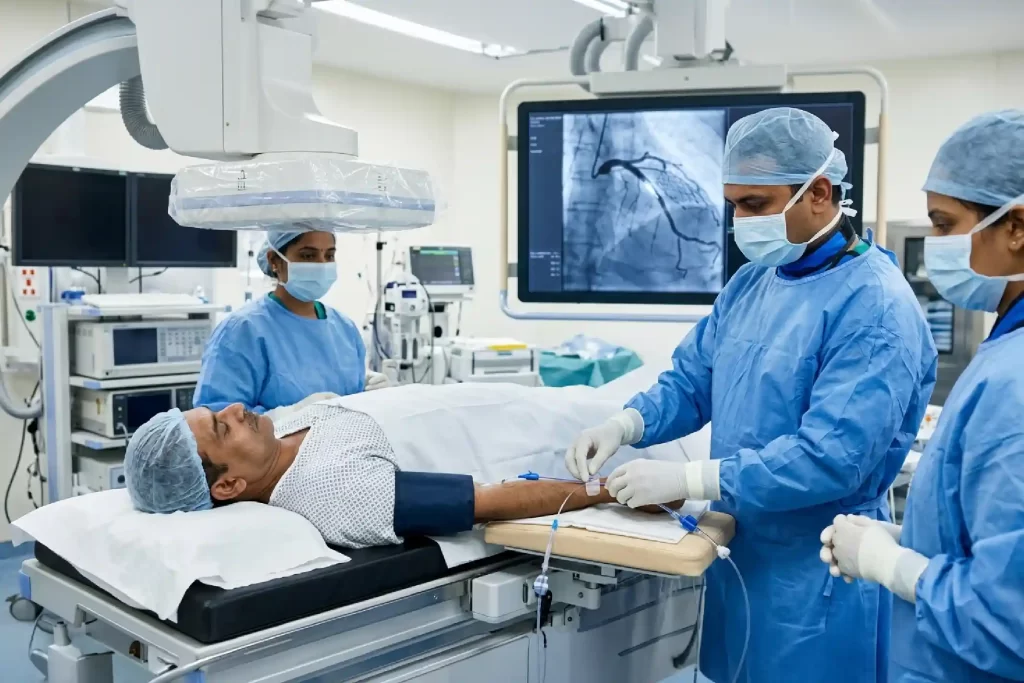
You Have Been Told You Need a Stent. But You Still Have Questions.
Being advised angioplasty or stenting can feel like a door closing rather than one opening. Your doctor has shown you the reports, explained the blockage, and recommended a procedure. But somewhere in that conversation, a question formed that you may not have asked out loud — is this the only option? Is there something that can help my heart without going through a procedure?
That question is not unreasonable. It is the kind of question that deserves a clear, medically grounded answer — not reassurance, and not dismissal.
What Angioplasty and Stenting Actually Involve
Angioplasty is a procedure in which a thin tube is passed through a blood vessel — usually from the wrist or groin — and guided to the site of a coronary blockage. A small balloon at the tip is inflated to widen the artery, and in most cases, a metal mesh tube called a stent is placed to keep the artery open. The procedure is performed under local anesthesia and sedation, typically requiring at least one night of hospital observation.
Angioplasty is a well-established intervention for specific cardiac situations, particularly when a blockage is causing acute or severe symptoms. However, it is also an invasive procedure — a foreign device is permanently placed inside a coronary artery. Some patients experience restenosis, meaning the artery narrows again at the stent site, and a small proportion require repeat procedures. For patients with stable symptoms, the question of whether an immediate interventional procedure is necessary is one that is increasingly being discussed in non-invasive cardiology.
How EECP Addresses Coronary Blockage Without Entering the Body
EECP vs angioplasty in Chennai is a comparison that more patients are raising because the two approaches address the same underlying problem — insufficient blood flow to the heart — in fundamentally different ways. EECP, or Enhanced External Counterpulsation, works entirely from outside the body. Pressure cuffs placed on the legs inflate and deflate in coordination with the heartbeat, pushing oxygen-rich blood toward the coronary arteries during each cardiac rest phase.
Over a full course of 35 sessions, this repeated stimulation encourages the heart to develop collateral circulation — naturally formed small vessels that create alternative pathways around narrowed or blocked arteries. No device is inserted. No artery is physically opened. No anesthesia is required. Patients attend one-hour sessions five days a week and leave the clinic the same day. For patients who want to understand the full mechanism behind how EECP builds these natural channels, our How EECP Works page explains it clearly and in plain language.
How EECP and Angioplasty Compare Across the Factors That Matter to Patients
This comparison is best understood through the specific dimensions that patients weigh when making a cardiac treatment decision.
Invasiveness: Angioplasty involves inserting a catheter into the body and placing a permanent stent inside a coronary artery. EECP involves no insertion of any kind — the entire treatment is external.
Hospitalization: Angioplasty requires at least one night of hospital admission and a period of restricted activity afterward. EECP is a fully outpatient therapy with no recovery period between sessions.
Repeat procedures: Some stents develop re-blockage over time, requiring repeat angioplasty. EECP does not leave a device inside the body and can be repeated as a course if needed in the future.
Suitable conditions: Angioplasty is typically recommended for significant single or multi-vessel disease causing unstable or acute symptoms. EECP is most appropriate for patients with stable angina, moderate coronary artery disease, or those with symptoms that persist after a prior stent or bypass.
For patients who have already undergone angioplasty and are still experiencing chest pain or breathlessness, EECP can serve as a non-stenting cardiac treatment that addresses symptoms without further intervention. This is a particularly relevant scenario that Dr. Krishnaraja sees regularly among patients arriving in and across Chennai & its Surroundings.
Why Patients Considering or Recovering From Angioplasty Choose KGK Hospital
At KGK Hospital on Poonamallee High Road, Arumbakkam, patients arrive at two very different stages — those who have been advised angioplasty and want to explore alternatives before committing, and those who have already had a stent placed but continue to experience symptoms and are looking for further support.
Both groups receive the same careful, unhurried assessment. Dr. Krishnaraja reviews the current cardiac reports, the nature of the blockage or symptoms, and the patient’s full medical history before discussing whether EECP is appropriate. He does not offer EECP as a universal substitute for angioplasty — he offers it as a clinically supported option for the right patient profile, explained honestly.
The clinic is open six days a week – Monday to Saturday from 09:00 AM to 5:00 PM, making it accessible for patients travelling from Kilpauk, T Nagar, Nungambakkam, Koyambedu, and surrounding areas. The non-surgical, no-admission model also means that patients who cannot afford extended leave from work or family responsibilities can complete a full treatment course without major disruption to their daily lives.
For patients who want to understand the cost involved before their visit, the EECP Session Packages and Pricing page provides a transparent breakdown of what the full course includes.
A Conversation Before a Procedure Is Always Worth Having
If you have been advised angioplasty and want to understand whether EECP vs angioplasty in Chennai is a comparison worth exploring for your specific condition, a consultation with Dr. Krishnaraja is the right starting point. Call or reach KGK Hospital on WhatsApp to book your appointment at Poonamallee High Road, Arumbakkam. The clinic is open Monday to Saturday, 09:00 AM to 5:00 PM. The consultation is a medical review, not a commitment — and leaving with more information is always better than proceeding without it.
This page is for general informational purposes only and does not constitute a recommendation to avoid or delay any medically advised procedure. Patients are strongly advised to consult Dr. K G Krishnaraja or a qualified cardiac physician for an individualized assessment before making any treatment decision.
Frequently Asked Questions
What is your service?
Lorem ipsum dolor sit amet, consectetur adipiscing elit. Ut elit tellus, luctus nec ullamcorper mattis, pulvinar dapibus leo.
Where are you located?
Lorem ipsum dolor sit amet, consectetur adipiscing elit. Ut elit tellus, luctus nec ullamcorper mattis, pulvinar dapibus leo.
Wait. What is WordPress?
Lorem ipsum dolor sit amet, consectetur adipiscing elit. Ut elit tellus, luctus nec ullamcorper mattis, pulvinar dapibus leo.
- How We Work
You are capable of breaking free from negative thought patterns
Appointment
Dictum ornare torquent pretium litora risus odio vulputate feugiat amet
Consultation
Dictum ornare torquent pretium litora risus odio vulputate feugiat amet
Sessions
Dictum ornare torquent pretium litora risus odio vulputate feugiat amet
Evaluation
Dictum ornare torquent pretium litora risus odio vulputate feugiat amet
